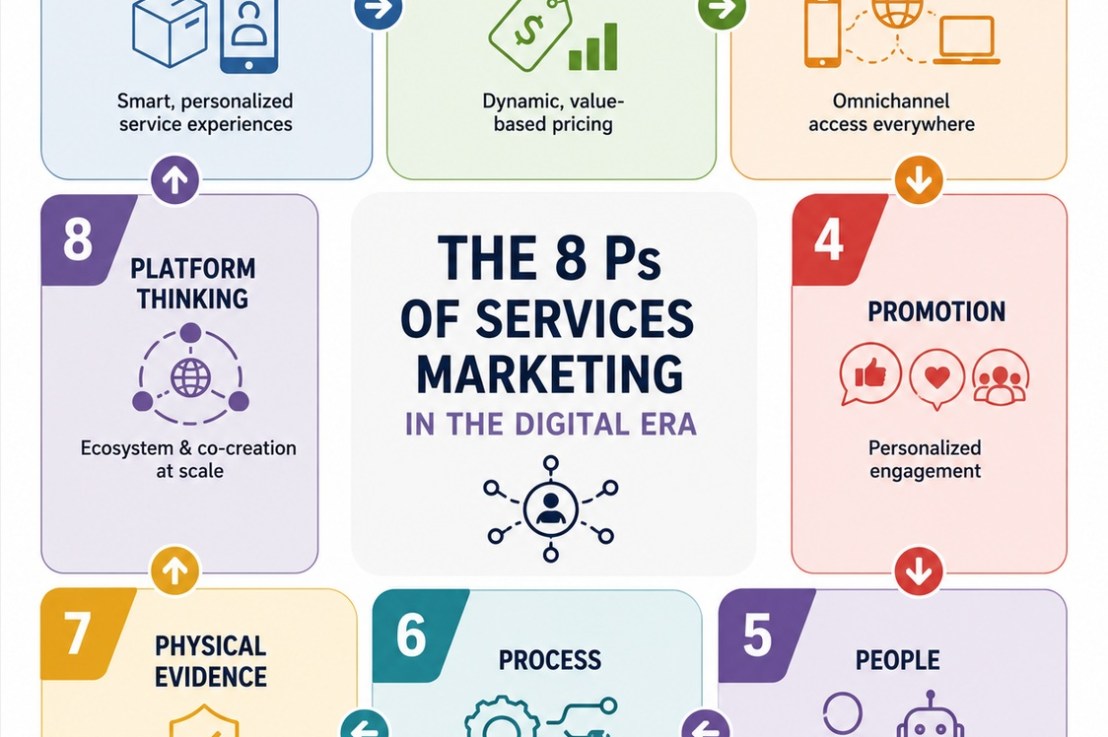
For decades, the 7Ps of the services marketing mix — Product, Price, Place, Promotion, People, Process, and Physical Evidence have provided managers with a practical framework for designing and delivering superior customer experiences. Originally developed to address the unique characteristics of services—intangibility, inseparability, heterogeneity, and perishability—the framework assumed that firms exercised considerable control over customer interactions. The digital era has fundamentally altered this assumption.
Artificial intelligence (AI), cloud computing, mobile technologies, social media, digital platforms, the Internet of Things (IoT), blockchain, and generative AI have transformed not only how services are delivered but also how they are conceived, co-created, and continuously improved. Today, customers interact with organizations across multiple digital touchpoints, influence one another through online communities, and increasingly collaborate with intelligent algorithms rather than human employees. Consequently, the traditional 7Ps have not become obsolete; rather, they have evolved into dynamic capabilities that enable organizations to compete in digitally connected ecosystems.
The organizations leading today’s service economy understand that digital transformation is not about replacing the marketing mix but reimagining each element through data, automation, and customer-centric innovation.
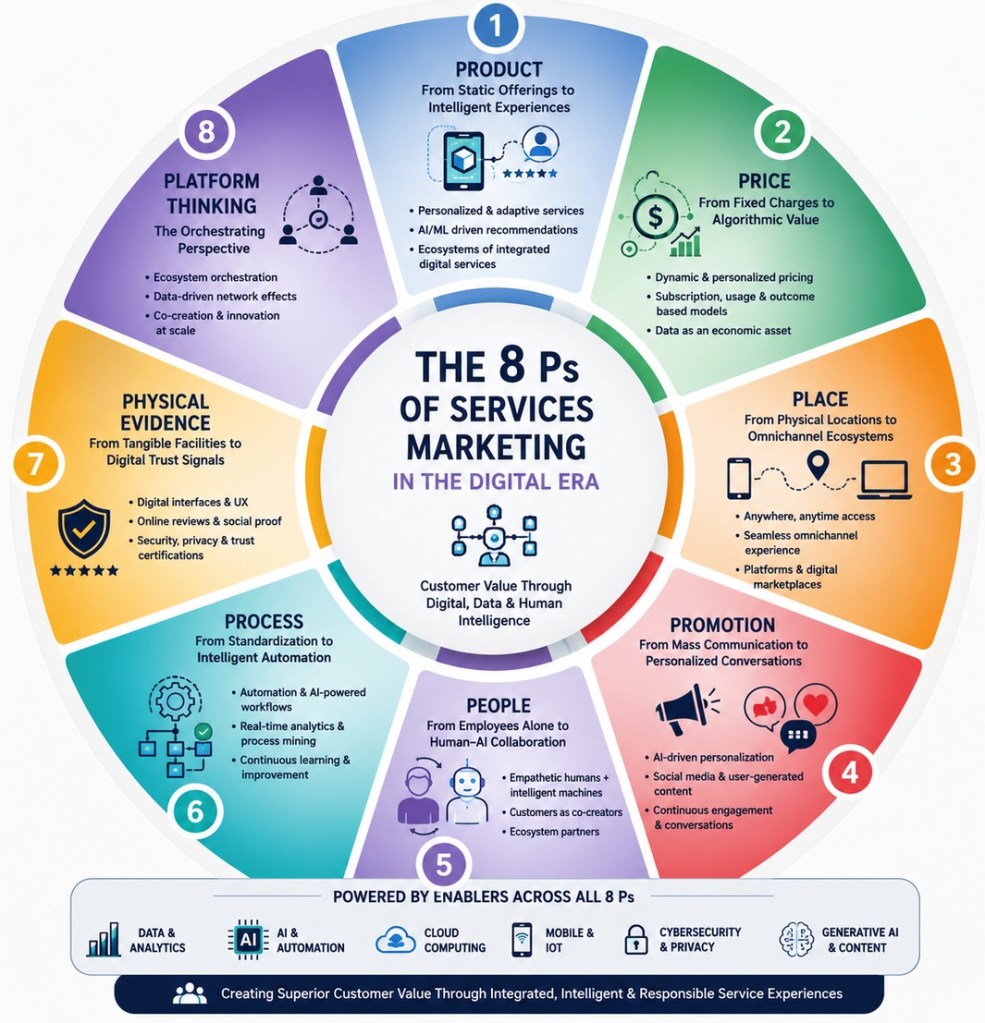
Product: From Static Service Offerings to Intelligent Experiences
In the digital era, the notion of “product” has expanded beyond a discrete service offering into an intelligent, adaptive experience. Traditional services were largely standardized and improved through periodic redesigns. Today, AI enables continuous personalization based on customer behavior, preferences, and contextual data. Streaming platforms recommend individualized content, banks provide personalized financial advice through AI-powered assistants, and healthcare providers increasingly use predictive analytics to customize patient care pathways. Services are no longer consumed identically by every customer; they evolve in real time.
Generative AI further accelerates this transformation by allowing organizations to create personalized reports, educational content, financial plans, and customer communications at scale. The service itself becomes adaptive rather than fixed. Moreover, digital ecosystems have blurred industry boundaries. Customers increasingly purchase integrated solutions rather than isolated services. Mobility platforms combine transportation, payments, navigation, insurance, and entertainment into a seamless customer experience. The “product” therefore becomes an ecosystem of interconnected digital services.
Price: From Fixed Charges to Algorithmic Value
Pricing has undergone one of the most dramatic transformations. Traditional service pricing relied on fixed rates, negotiated contracts, or cost-plus models. Digital technologies have introduced dynamic, personalized, and outcome-based pricing mechanisms. Airlines, hotels, ride-sharing platforms, and online retailers continuously adjust prices based on demand, customer behavior, competitor actions, and inventory availability. AI-powered pricing engines optimize revenues while responding instantly to market conditions.
Subscription-based business models have become equally important. Software-as-a-Service (SaaS), streaming services, online education platforms, and digital health providers increasingly charge recurring subscription fees instead of one-time transactions. Customers are also paying with data. Personalized recommendations, free digital services, and platform participation often involve implicit exchanges where customer information becomes an economic asset. Consequently, managers must think beyond monetary price toward perceived value, privacy costs, and trust. The emergence of usage-based pricing, freemium models, and outcome-based contracts illustrates how digital technologies have made pricing significantly more flexible and customer-centric.
Place: From Physical Locations to Omnichannel Ecosystems
The concept of place has expanded from geographic distribution to digital accessibility. Historically, service delivery depended on physical proximity—bank branches, retail outlets, hospitals, or university campuses. Digital technologies have largely eliminated these spatial constraints. Cloud computing enables organizations to deliver services globally with minimal physical infrastructure. Customers expect to initiate transactions on smartphones, continue them on laptops, and complete them through voice assistants without interruption.
The omnichannel experience has therefore become the new definition of place. Physical and digital channels no longer compete but complement each other. Retail banking illustrates this transformation well. Customers may open an account through a mobile app, consult an advisor via video conferencing, visit a branch only for specialized services, and receive ongoing support through AI chatbots. Digital platforms similarly function as marketplaces where producers, consumers, and complementary service providers interact simultaneously. Place is no longer where the service exists—it is wherever the customer chooses to engage.
Promotion: From Mass Communication to Personalized Conversations
Marketing communication has shifted from broadcasting messages to facilitating ongoing conversations. Traditional promotion relied heavily on television, newspapers, radio, and outdoor advertising. Digital technologies have democratized communication by allowing customers to become influential content creators themselves. Organizations now use AI-driven segmentation to deliver highly personalized messages based on behavioral analytics, browsing history, purchase intent, and contextual signals.
Social media platforms have transformed customers into brand advocates—or critics. User-generated content, online reviews, influencer marketing, and digital communities often exert greater influence than corporate advertising. Generative AI has introduced unprecedented scalability in content creation. Firms can rapidly generate customized emails, product descriptions, advertisements, multilingual campaigns, and conversational responses tailored to individual customer segments. Promotion has therefore evolved into continuous engagement rather than episodic campaigns. Organizations increasingly compete on relevance, authenticity, responsiveness, and transparency.
People: From Employees Alone to Human–AI Collaboration
Among the original 7Ps, “People” has experienced perhaps the most profound conceptual shift. Traditionally, service quality depended primarily on frontline employees who interacted directly with customers. Today, customers frequently interact first with intelligent technologies—chatbots, virtual assistants, recommendation engines, robotic process automation, or autonomous service systems.
This does not diminish the importance of people; rather, it changes their roles in the era of automation. Employees increasingly focus on empathy, creativity, complex problem solving, and relationship management while AI handles routine, repetitive, and information-intensive tasks. Successful organizations are designing hybrid service systems where humans and intelligent machines complement one another. Healthcare professionals work alongside AI diagnostic tools. Financial advisors use predictive analytics to improve investment recommendations. Customer support teams rely on generative AI to provide faster and more accurate responses.
Equally important, customers themselves have become active participants in value creation through self-service technologies, online communities, crowdsourcing, and digital feedback mechanisms. Thus, “People” now encompasses employees, customers, intelligent agents, and ecosystem partners working collaboratively.
Process: From Standardization to Intelligent Automation
Service processes have evolved from linear workflows into intelligent, data-driven, adaptive systems. Digital technologies enable organizations to automate routine operations while simultaneously improving speed, accuracy, and scalability. Robotic Process Automation (RPA), AI, blockchain, and cloud-based workflows reduce operational friction across customer journeys. Organizations increasingly monitor every customer interaction through digital analytics, allowing continuous process optimization rather than periodic process redesign.
Process mining techniques identify bottlenecks automatically, while predictive analytics anticipates customer needs before service failures occur. Generative AI introduces an additional layer of process intelligence by automating knowledge-intensive activities such as document preparation, report generation, coding assistance, legal drafting, and customer communications. The result is not merely greater efficiency but greater agility. Service processes continuously learn, adapt, and improve through data-driven feedback loops.
Physical Evidence: From Tangible Facilities to Digital Trust Signals
Services remain intangible, but the evidence customers use to evaluate them has changed dramatically. Historically, customers assessed quality through physical surroundings—office design, employee appearance, brochures, equipment, and facilities. Today, digital interfaces constitute the primary physical evidence of service quality. Website usability, mobile application design, interface responsiveness, cybersecurity, privacy protections, customer ratings, online reviews, social proof, and digital certifications collectively shape customer perceptions.
Trust has become the new physical evidence. Customers increasingly judge organizations based on transparent data practices, secure payment systems, AI explainability, ethical governance, and responsible use of customer information. For AI-enabled services, explainable algorithms and responsible AI practices become visible signals of organizational credibility. Consequently, digital trust architectures are replacing physical infrastructure as critical indicators of service quality.
Toward an Eighth Perspective: Platform Thinking
Although the traditional 7Ps remain highly relevant, digital transformation suggests an overarching managerial principle that connects them all: platform thinking. Rather than optimizing each marketing variable independently, organizations increasingly orchestrate ecosystems where customers, partners, developers, AI systems, and complementary service providers jointly create value. Data flows across all seven elements, enabling continuous learning, personalization, and innovation. The firms outperforming competitors today are not simply digitizing existing services; they are redesigning entire service ecosystems around customer journeys, intelligent automation, and network effects.
Conclusion
The digital era has fundamentally reshaped the services marketing mix without invalidating its foundational principles. Each of the seven elements has evolved from a relatively static managerial decision into a dynamic capability enabled by digital technologies. Products have become intelligent experiences, pricing has become algorithmic, place has expanded into omnichannel ecosystems, promotion has become conversational, people now include both humans and AI, processes have become adaptive and automated, and physical evidence increasingly consists of digital trust signals. For managers, the strategic challenge is no longer deciding whether to digitize individual marketing activities. It is integrating all seven elements into a coherent, data-driven service ecosystem that continuously learns from customers and evolves alongside their expectations. Organizations that successfully align the 7Ps with AI, analytics, platforms, and responsible digital governance will be best positioned to create superior customer value and sustain competitive advantage in an increasingly intelligent service economy.


