Organizations have traditionally viewed sustainability and operational performance as competing priorities. Sustainability initiatives often required additional investments, longer implementation horizons, and complex organizational changes, while operations focused primarily on cost, quality, speed, and productivity. However, Generative Artificial Intelligence (GenAI) is fundamentally altering this equation. Rather than forcing organizations to choose between operational efficiency and environmental stewardship, GenAI enables firms to pursue both simultaneously. It represents a transformative capability that integrates sustainability into everyday operational decision-making rather than treating it as a separate corporate responsibility initiative.
Unlike conventional analytics that primarily describe historical performance, GenAI can synthesize vast quantities of structured and unstructured information, generate context-aware recommendations, automate knowledge-intensive tasks, and continuously optimize operational processes. This ability makes GenAI particularly valuable for organizations attempting to achieve ambitious Environmental, Social, and Governance (ESG) objectives while maintaining competitiveness in increasingly volatile markets.
The future of sustainable operations, therefore, will not merely depend on reducing environmental impacts but on building intelligent operational systems capable of learning, adapting, and continuously improving sustainability performance.
Sustainability Is Becoming an Operational Challenge
The sustainability agenda has evolved considerably over the past decade. Regulatory mandates, investor expectations, customer preferences, and climate-related disruptions have collectively transformed sustainability into a core operational concern. Organizations are now expected to reduce carbon emissions, minimize waste generation, optimize energy consumption, improve circularity, and ensure ethical sourcing across increasingly complex global supply chains.
Achieving these objectives requires organizations to process enormous amounts of heterogeneous information. Operational data originate from production systems, logistics networks, suppliers, energy grids, IoT sensors, maintenance records, procurement documents, sustainability reports, customer feedback, weather forecasts, and regulatory frameworks. Human managers often struggle to integrate these diverse information sources into coherent operational decisions.
GenAI addresses precisely this challenge by functioning as an intelligent orchestration layer that combines operational intelligence with sustainability objectives. Instead of optimizing isolated functions, it enables organizations to optimize entire operational ecosystems while considering environmental constraints alongside traditional performance indicators.
Consequently, sustainability shifts from being an annual reporting exercise to becoming a continuous operational capability.

Intelligent Resource Optimization
Resource efficiency remains the cornerstone of sustainable operations. Every unit of wasted energy, material, labor, or transportation contributes simultaneously to higher operational costs and larger environmental footprints.
GenAI significantly enhances resource optimization by identifying complex consumption patterns that traditional optimization models frequently overlook. By integrating historical operational records with real-time production information, GenAI recommends adjustments in production schedules, equipment utilization, inventory allocation, workforce deployment, and transportation planning.
For instance, manufacturing organizations can use GenAI to dynamically redesign production schedules that minimize electricity consumption during peak tariff periods while maintaining customer service levels. Similarly, warehouses can optimize storage layouts, picking sequences, and workforce assignments to reduce equipment movement and energy consumption.
Unlike static optimization approaches, GenAI continuously learns from changing operational conditions, enabling organizations to respond proactively rather than reactively to resource inefficiencies.
The result is simultaneous improvement in operational productivity and environmental performance.
Building Energy-Intelligent Operations
Industrial facilities consume enormous quantities of electricity, water, fuel, heating, and cooling resources. Traditional energy management systems typically rely on predefined rules and historical averages.
GenAI introduces adaptive intelligence into energy management by integrating weather conditions, occupancy patterns, production schedules, equipment conditions, renewable energy availability, and market electricity prices into a unified decision framework. Instead of simply monitoring energy consumption, GenAI predicts future demand, recommends preventive interventions, and automatically generates optimized operating scenarios.
For example, production-intensive facilities can shift non-critical processes toward periods of abundant renewable energy generation. Commercial buildings can automatically adjust heating, ventilation, lighting, and cooling systems according to occupancy predictions while preserving employee comfort. These capabilities reduce operational costs while directly contributing to carbon reduction targets.
Creating Circular Supply Chains
One of the greatest sustainability challenges lies beyond organizational boundaries. Modern supply chains involve thousands of suppliers operating across multiple countries with varying environmental standards and regulatory requirements.
GenAI improves supply chain sustainability by analyzing supplier documentation, sustainability reports, procurement contracts, logistics data, and risk signals to generate comprehensive sustainability intelligence. Organizations can identify suppliers with excessive carbon emissions, predict disruption risks associated with climate events, recommend alternative sourcing strategies, and optimize transportation routes that minimize fuel consumption.
Furthermore, GenAI supports circular economy initiatives by identifying opportunities for material reuse, product refurbishment, remanufacturing, and recycling. Rather than disposing products at the end of their life cycle, organizations can use AI-generated recommendations to recover economic value while minimizing environmental impacts.
This transforms supply chains from linear resource consumption systems into regenerative operational ecosystems.
Reducing Waste Through Predictive Intelligence
Waste represents one of the clearest indicators of operational inefficiency. Excess inventory, defective production, unnecessary transportation, expired materials, and equipment failures all generate avoidable environmental burdens. GenAI enables organizations to anticipate waste before it occurs. By combining quality records, maintenance logs, sensor information, operator notes, and production histories, GenAI predicts process deviations that are likely to generate defects or excessive scrap.
Similarly, predictive maintenance supported by GenAI identifies equipment degradation before catastrophic failures occur, reducing downtime while extending asset life. Inventory optimization also becomes significantly more intelligent. Instead of relying solely on statistical demand forecasts, GenAI incorporates market trends, economic signals, customer sentiment, seasonal variations, and external events into inventory planning.
Lower inventory obsolescence directly reduces waste while simultaneously improving working capital performance.
Accelerating Sustainable Product Design
Product design determines a substantial proportion of an organization’s lifetime environmental footprint. Material selection, manufacturing methods, packaging choices, transportation requirements, repairability, and recyclability are largely determined during early design stages.
GenAI substantially accelerates sustainable innovation by generating alternative design concepts that simultaneously satisfy functional, economic, and environmental objectives. Engineers can use GenAI to evaluate different material combinations, estimate life-cycle emissions, recommend lightweight structures, identify recyclable alternatives, and simulate environmental trade-offs before physical prototyping begins.
Because GenAI dramatically reduces design iteration cycles, organizations can explore a much larger solution space than was previously economically feasible. This democratizes sustainable innovation across industries rather than limiting it to organizations with extensive R&D resources.
Empowering Employees as Sustainability Decision Makers
Technology alone does not create sustainable operations. Employees remain central to operational execution, continuous improvement, and organizational learning. One of GenAI’s greatest contributions lies in democratizing sustainability knowledge. Instead of requiring employees to interpret lengthy environmental regulations or technical sustainability manuals, GenAI provides contextual guidance during everyday operational activities.
Maintenance technicians receive environmentally optimized repair recommendations. Procurement managers receive supplier sustainability assessments during purchasing decisions. Production planners obtain carbon-aware scheduling recommendations. Logistics coordinators receive optimized routing suggestions balancing cost, delivery speed, and emissions.
By embedding sustainability expertise directly into operational workflows, GenAI transforms every employee into an informed sustainability contributor. This significantly reduces dependence on specialized sustainability teams while accelerating organizational capability development.
Enhancing ESG Reporting and Regulatory Compliance
Sustainability reporting has become increasingly complex due to expanding ESG disclosure requirements across multiple jurisdictions. Organizations often spend considerable resources collecting fragmented information from different departments before preparing sustainability reports.
GenAI automates much of this process. It extracts information from operational systems, supplier documents, financial records, audit reports, and regulatory filings before generating draft sustainability disclosures consistent with reporting standards. More importantly, GenAI improves transparency by identifying inconsistencies, missing data, potential compliance gaps, and emerging regulatory risks before reports are submitted. This shifts ESG reporting from retrospective documentation toward proactive sustainability management.
The Governance Challenge
Despite its considerable promise, GenAI introduces important governance challenges that organizations cannot ignore. AI systems themselves consume significant computational resources and electricity, particularly large foundation models requiring extensive training and inference capabilities. Organizations must therefore evaluate whether the environmental benefits generated through operational optimization exceed the carbon footprint associated with AI deployment.
Moreover, inaccurate recommendations, hallucinated outputs, biased training data, cybersecurity vulnerabilities, and limited explainability may undermine sustainability decisions if organizations rely excessively on automated recommendations. Successful implementation therefore requires human oversight, transparent AI governance, high-quality operational data, continuous monitoring, and clearly defined accountability structures. Rather than replacing managerial judgment, GenAI should augment human expertise through collaborative intelligence.
From Sustainable Operations to Regenerative Operations
The greatest opportunity offered by GenAI extends beyond operational efficiency. It enables organizations to reimagine operations as adaptive systems capable of continuously regenerating economic, environmental, and social value.
Future operational systems will increasingly function as intelligent ecosystems where digital twins simulate sustainability scenarios, autonomous agents coordinate supply chains, predictive models anticipate climate disruptions, and GenAI continuously recommends operational improvements across organizational boundaries. Instead of merely minimizing environmental harm, organizations will increasingly design operations that restore ecosystems, reduce resource intensity, improve resilience, and strengthen stakeholder well-being.
The process perspective is important to achieve these goals.
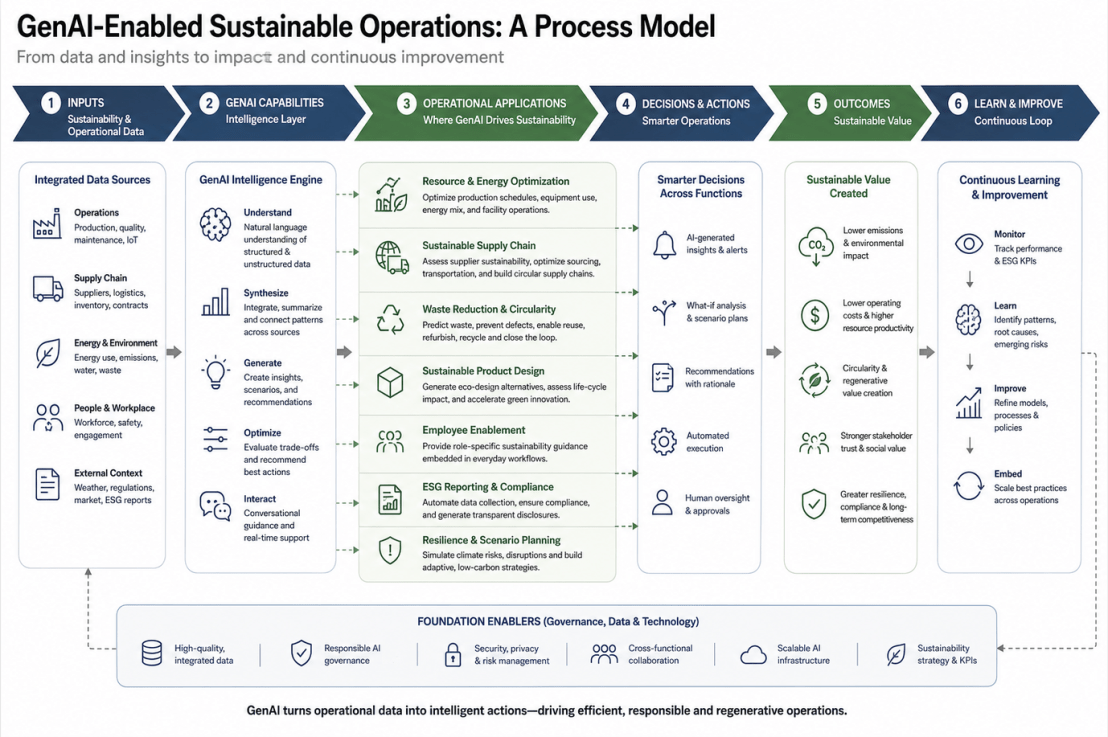
Sustainability in operations is no longer achieved through isolated environmental initiatives or periodic efficiency improvements. Instead, it requires organizations to continuously integrate environmental, economic, and social considerations into everyday operational decisions. The process model of Generative Artificial Intelligence (GenAI)-enabled sustainable operations provides a systematic framework that explains how organizations can transform raw operational data into intelligent actions that create long-term sustainable value. Rather than viewing GenAI as a standalone technology, the model conceptualizes it as an organizational capability that orchestrates data, knowledge, decision-making, and continuous learning across the operational ecosystem.
The process begins with integrated operational and sustainability data, which serve as the primary inputs. Organizations generate enormous volumes of information from production systems, supply chains, inventory management, energy consumption, maintenance records, Internet of Things (IoT) sensors, environmental monitoring systems, workforce activities, and external sources such as weather forecasts, regulatory updates, and ESG disclosures. Individually, these data sources provide fragmented insights; collectively, they represent the digital foundation upon which sustainable operational intelligence can be built.
The second stage is the GenAI intelligence layer, where disparate information is transformed into actionable knowledge. Unlike conventional analytics that primarily analyze structured numerical data, GenAI synthesizes structured and unstructured information, interprets textual documents, generates contextual recommendations, and identifies relationships across multiple operational domains. It continuously learns from organizational knowledge and operational experiences, enabling managers to understand complex sustainability trade-offs and generate optimized alternatives for decision-making.
These AI capabilities are subsequently embedded into various operational applications that directly influence sustainability performance. GenAI supports intelligent resource and energy optimization by recommending efficient production schedules and reducing unnecessary resource consumption. It enhances supply chain sustainability through supplier evaluation, transportation optimization, and circular sourcing strategies. Simultaneously, predictive intelligence minimizes operational waste by anticipating equipment failures, production defects, and inventory obsolescence before they occur. GenAI also accelerates sustainable product design by recommending environmentally friendly materials and life-cycle improvements while empowering employees with contextual sustainability guidance during routine operational tasks. Furthermore, it automates ESG reporting and compliance activities and enables organizations to conduct scenario planning for climate risks and operational disruptions.
Insights generated from these operational applications translate into organizational decisions and actions. Managers receive AI-supported recommendations, predictive alerts, scenario analyses, and optimization strategies that facilitate more informed operational choices. Importantly, these recommendations remain subject to human oversight, ensuring that managerial judgment, ethical considerations, and organizational priorities continue to guide final decisions. In this sense, GenAI augments rather than replaces human expertise.
The cumulative effect of these decisions is reflected in a series of sustainability outcomes. Organizations experience reductions in carbon emissions, energy consumption, operational waste, and resource intensity while simultaneously improving productivity, resilience, and cost efficiency. Sustainable operations also strengthen stakeholder trust, regulatory compliance, and competitive advantage by embedding environmental responsibility into core business processes. Consequently, sustainability evolves from a compliance obligation into a strategic capability that supports long-term value creation.
The process concludes with a continuous learning and improvement loop, distinguishing GenAI-enabled operations from traditional optimization approaches. Operational outcomes generate new data that feed back into AI models, allowing the system to refine recommendations, detect emerging patterns, improve predictive accuracy, and adapt to changing business environments. This recursive learning capability enables organizations to continually enhance both operational performance and sustainability outcomes over time.
Supporting the entire process is a foundation of governance, data quality, technological infrastructure, cybersecurity, and responsible AI practices. These organizational enablers ensure that AI-generated recommendations remain transparent, reliable, secure, and aligned with sustainability objectives.
Viewed from a process perspective, sustainable operations emerge as an iterative cycle of sensing, understanding, deciding, acting, and learning. GenAI serves as the cognitive engine that connects these stages, enabling organizations to move beyond isolated efficiency improvements toward adaptive, intelligent, and regenerative operational systems capable of delivering enduring economic, environmental, and social value.
In this emerging paradigm, sustainability is no longer a compliance obligation or reputational initiative. It becomes an intrinsic property of intelligent operations. Organizations that successfully integrate GenAI into their operational strategies will not simply operate more efficiently—they will operate more responsibly, more adaptively, and more competitively. As sustainability becomes inseparable from operational excellence, GenAI will serve not merely as another digital technology, but as the cognitive engine enabling organizations to build resilient, circular, and regenerative operations for the decades ahead.


