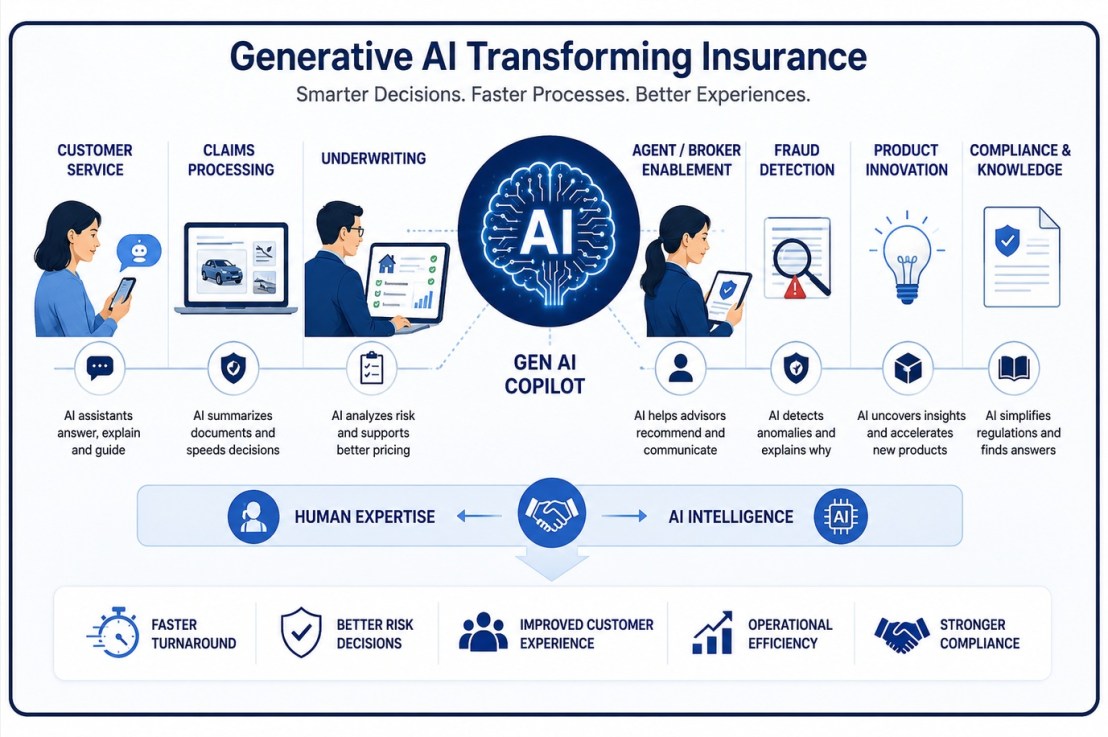
Insurance has long been built on a paradox. It is a business that exists to manage uncertainty, yet it has traditionally relied on processes that are remarkably certain—standardized underwriting guidelines, document-intensive claims handling, regulatory compliance, and actuarial models refined over decades. While insurers have invested heavily in predictive analytics, robotic process automation, and digital customer channels over the past two decades, much of the industry’s knowledge work has remained firmly in human hands. Underwriters still sift through hundreds of pages of risk reports before issuing policies. Claims adjusters continue to reconcile disparate documents before approving settlements. Customer service representatives spend countless hours interpreting complex policy language for anxious policyholders. The emergence of Generative Artificial Intelligence (GenAI) is beginning to redefine this landscape.
Unlike earlier generations of artificial intelligence that primarily classified information or predicted outcomes, Generative AI creates, synthesizes, and reasons over unstructured information. Large language models can read thousands of pages of policy documents, summarize medical reports, draft customer communications, compare regulatory requirements, and engage in natural conversations with customers and employees alike. For insurers, whose operations revolve around documents, language, and expert judgment, this represents a profound shift. Rather than automating isolated tasks, Generative AI augments decision-making across nearly every stage of the insurance value chain.
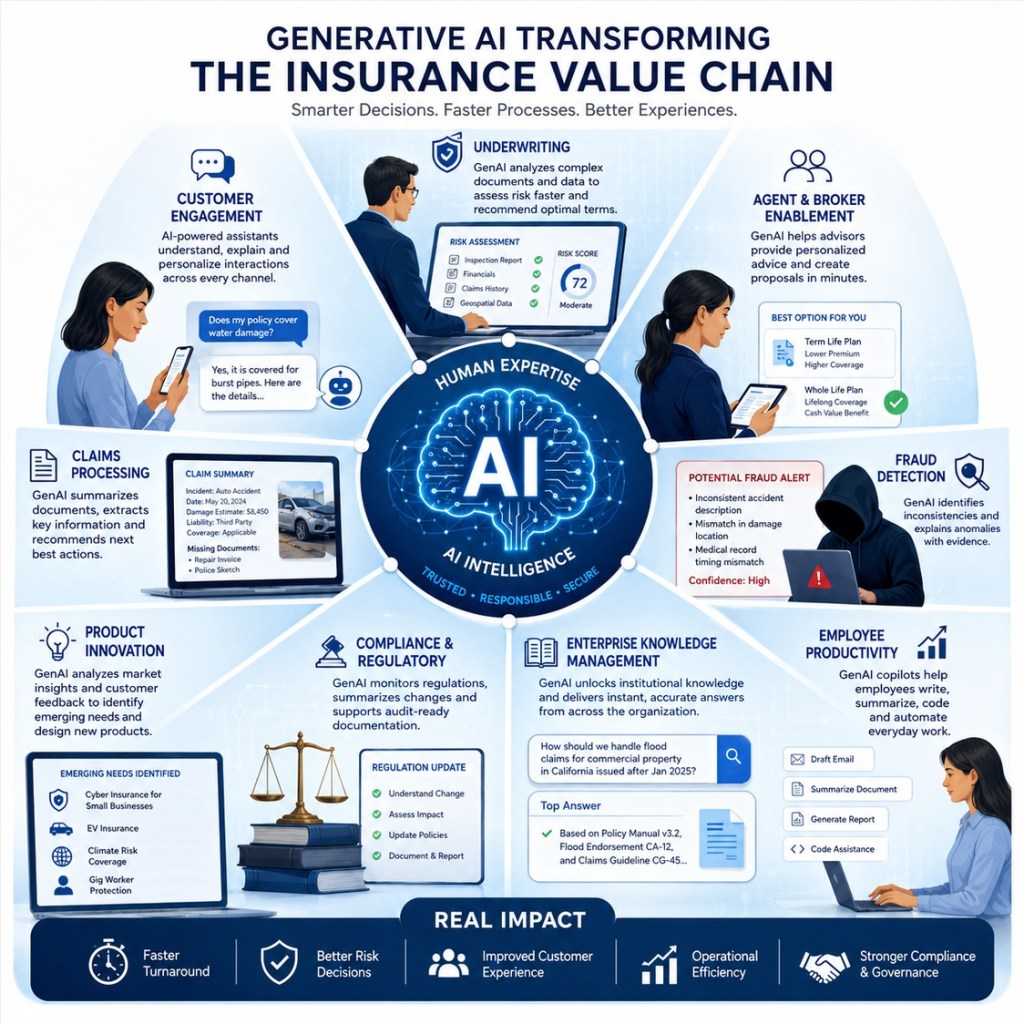
The first area experiencing significant transformation is customer engagement. Insurance products have always suffered from an information asymmetry: customers purchase promises written in highly technical language that they often do not fully understand until they need to file a claim. Traditional chatbots attempted to bridge this gap but were limited to scripted conversations and predefined responses. Generative AI changes the nature of customer interaction by enabling conversational systems capable of understanding context, interpreting policy documents, and providing personalized explanations.
Consider a homeowner who asks whether water damage caused by a burst pipe during an overseas vacation is covered under an existing policy. Rather than directing the customer to a lengthy policy document or offering a generic frequently asked question, an AI assistant can examine the relevant policy wording, identify applicable exclusions and endorsements, summarize the coverage in plain language, and explain the rationale behind its recommendation. If the issue requires human intervention, the AI transfers the interaction to a claims specialist together with a structured summary of the conversation, ensuring continuity and reducing customer frustration. Several insurers have adopted such AI copilots not to replace customer service representatives but to enable them to resolve complex inquiries more efficiently while maintaining a high level of personalization.
The claims function represents perhaps the greatest opportunity for Generative AI. Claims processing has historically been among the most labor-intensive activities within insurance, requiring adjusters to examine accident reports, repair estimates, invoices, medical records, photographs, witness statements, and correspondence before determining liability and compensation. Much of this effort involves reading and synthesizing information rather than making the final decision.
Generative AI fundamentally changes this workflow. Instead of manually reviewing hundreds of pages of documentation, adjusters receive concise summaries highlighting the chronology of events, key evidence, estimated damages, policy coverage, missing information, and potential anomalies. For example, after an automobile accident, an AI assistant can integrate police reports, repair estimates, photographs, and customer statements into a coherent narrative that identifies probable causes, recommends additional documentation if necessary, and flags inconsistencies requiring further investigation. Rather than replacing professional judgment, the technology reduces administrative burden, allowing adjusters to devote greater attention to negotiation, empathy, and exception handling.
A similar transformation is occurring in underwriting. Underwriting decisions require evaluating diverse sources of information including engineering inspections, environmental assessments, financial disclosures, historical claims, geographic risk data, and increasingly, climate-related information. Experienced underwriters often spend several hours synthesizing these heterogeneous datasets before making pricing decisions.
Generative AI functions as an intelligent underwriting copilot by rapidly consolidating information from multiple documents into concise risk assessments. An underwriter evaluating a manufacturing facility, for instance, may upload engineering inspection reports, environmental compliance certificates, historical claims records, and satellite-based risk assessments. Within minutes, the AI produces a structured briefing highlighting recurring loss patterns, emerging climate risks, operational strengths, regulatory issues, and recommended pricing considerations. Human expertise remains central to the underwriting decision, but much of the cognitive effort associated with document synthesis is dramatically reduced. The result is shorter underwriting cycles, greater consistency across distributed underwriting teams, and improved responsiveness to customers.
Beyond operational efficiency, Generative AI is also reshaping the role of insurance agents and brokers. Insurance has always been a relationship-driven business where trust plays a critical role in purchasing decisions. Customers rarely seek insurance products in isolation; they seek financial security for specific life situations such as purchasing a home, starting a family, or launching a business. Generative AI enables advisors to move beyond product descriptions toward personalized financial conversations.
When a customer asks whether term life insurance or whole-life insurance is more appropriate given a young family and a mortgage, the AI assistant can instantly compare policy features, explain trade-offs in accessible language, estimate long-term costs, and prepare customized illustrations. Rather than searching through multiple product manuals or technical brochures, agents receive synthesized insights that improve both the quality and speed of customer interactions. Consequently, advisors spend less time retrieving information and more time cultivating relationships and understanding customer needs.
Insurance fraud provides another compelling application. Fraud detection has traditionally relied on predictive models trained on structured variables such as claim frequency, transaction histories, and customer demographics. However, many fraudulent claims emerge not from numerical anomalies but from inconsistencies across narratives dispersed among police reports, witness statements, medical records, repair invoices, and claimant descriptions.
Generative AI excels at identifying such narrative inconsistencies. Consider an automobile accident where the claimant describes a rear-end collision while repair invoices indicate frontal damage and witness statements place the accident at a different location. Instead of merely assigning a fraud probability score, the AI generates an interpretable explanation identifying the conflicting evidence and recommending further investigation. Such narrative reasoning enhances investigator productivity while improving transparency and explainability—qualities increasingly demanded by regulators overseeing AI-based decision-making.
The influence of Generative AI extends beyond frontline operations into product innovation. Insurance products have traditionally evolved slowly because developing new offerings requires analyzing customer feedback, interpreting emerging risks, drafting policy language, ensuring regulatory compliance, and coordinating multiple organizational functions. Large language models accelerate this process by synthesizing customer complaints, broker feedback, competitor offerings, regulatory developments, and social media discussions to identify unmet market needs.
For example, insurers have begun exploring new products addressing cyber risks for small businesses, electric vehicle ownership, climate-related property damage, and coverage for gig economy workers. Generative AI enables product teams to rapidly prototype policy language, marketing materials, and customer communications while allowing legal and actuarial experts to focus on validation rather than drafting from scratch. Innovation cycles that once required months can increasingly be completed within weeks.
Regulatory compliance, another cornerstone of insurance operations, is similarly benefiting from Generative AI. Insurance companies operate under extensive legal and regulatory requirements spanning product disclosures, solvency regulations, consumer protection, privacy legislation, and reporting obligations. Compliance professionals must continuously monitor evolving regulations and assess their operational implications.
Generative AI assists these professionals by summarizing regulatory updates, identifying conflicts between new regulations and existing internal procedures, drafting compliance documentation, and generating audit-ready reports. Rather than manually reviewing hundreds of pages of legal text, compliance officers receive concise analyses highlighting material changes and recommended organizational responses. Importantly, final regulatory interpretations remain under human oversight, ensuring accountability while significantly reducing administrative workload.
Perhaps the most transformative application lies within enterprise knowledge management. Large insurance organizations possess decades of institutional knowledge embedded within underwriting manuals, policy documents, historical claims, legal precedents, internal guidelines, and technical documentation. Employees frequently struggle to locate relevant information despite its existence within organizational repositories.
Generative AI effectively converts this fragmented institutional memory into an accessible conversational knowledge system. An underwriter seeking guidance on flood coverage for commercial properties or a claims adjuster interpreting an uncommon policy endorsement can simply ask questions in natural language. The AI retrieves relevant documents, synthesizes key information, explains policy provisions, and references applicable internal procedures within seconds. Knowledge that previously remained trapped within organizational silos becomes immediately available across the enterprise, improving consistency and reducing dependence on individual expertise.
Leading insurers have already begun operationalizing these capabilities. Global organizations such as Allstate, Allianz, AXA, Zurich Insurance Group, Prudential Financial, Ping An Insurance, Swiss Re, and Aflac have introduced Generative AI across customer service, underwriting support, claims processing, software development, enterprise search, and employee productivity. While implementation strategies differ, a common pattern has emerged: the technology is being deployed primarily as a copilot that augments professional expertise rather than replacing it. Underwriters remain responsible for pricing complex risks, claims professionals continue to exercise judgment in disputed cases, and compliance officers retain accountability for regulatory decisions. Generative AI accelerates information processing, but human expertise continues to determine outcomes.
This distinction is critical because insurance remains fundamentally a business of judgment rather than computation. Policies frequently involve ambiguity, exceptional circumstances, ethical considerations, and evolving legal interpretations that cannot be fully automated. The strategic value of Generative AI therefore lies not in eliminating professionals but in amplifying their capabilities. Employees spend less time searching for information, drafting routine documents, or summarizing reports, allowing them to devote greater attention to customer relationships, analytical reasoning, and strategic decision-making.
The broader implication is that insurance is transitioning from a document-centric industry to an intelligence-centric one. Earlier waves of digital transformation automated workflows and digitized customer interactions, but Generative AI integrates knowledge, language, and reasoning directly into business processes. Organizations are no longer simply digitizing insurance; they are redesigning how insurance expertise is created, shared, and applied. As regulatory expectations surrounding responsible AI continue to evolve, insurers will increasingly differentiate themselves not by the sophistication of their algorithms alone, but by their ability to combine trustworthy AI with human judgment, transparency, and governance.
History suggests that technological revolutions rarely eliminate expertise; they redefine where expertise creates value. Generative AI appears poised to follow the same trajectory within insurance. The competitive advantage of the future will belong not to insurers that automate the greatest number of tasks, but to those that most effectively orchestrate collaboration between human professionals and intelligent machines. In an industry whose purpose is to reduce uncertainty, Generative AI may ultimately become the technology that enables insurers to make faster, more informed, and more empathetic decisions in an increasingly uncertain world.


