Artificial Intelligence Is Reshaping U.S. Markets. What Does That Mean for India?
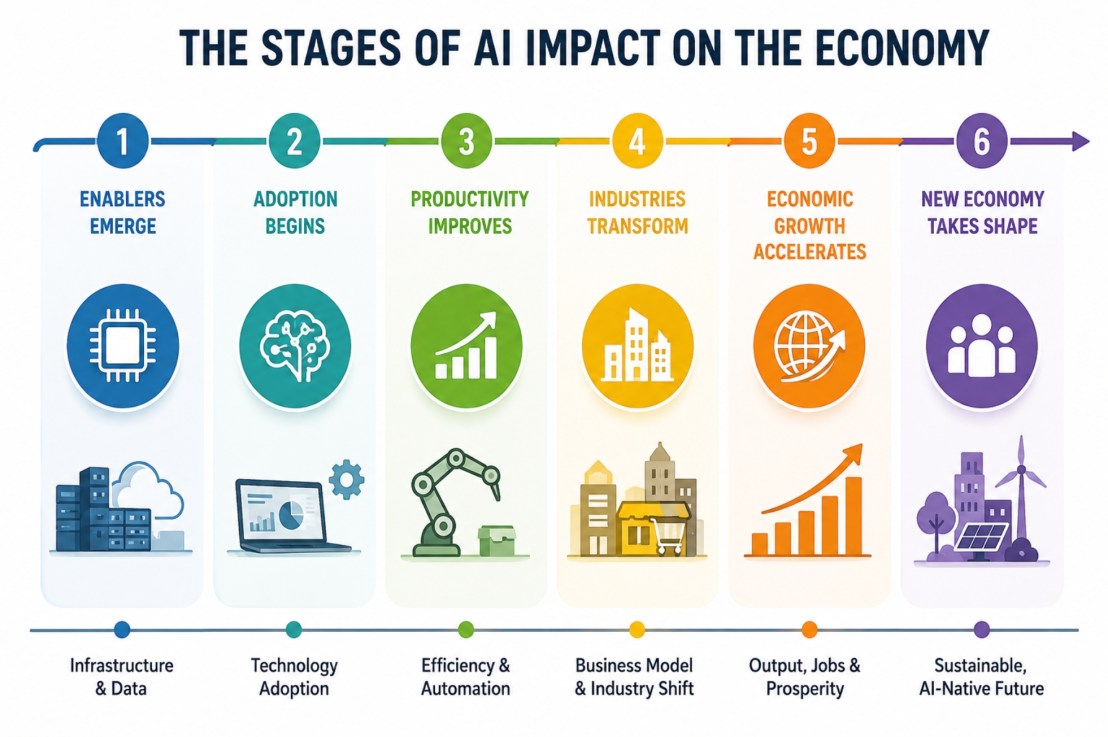
The rise of artificial intelligence (AI) has become the defining economic story of the decade. Unlike previous technological waves that primarily transformed individual industries, AI is emerging as a general-purpose technology with the potential to reshape virtually every sector of the economy. In the United States, AI is no longer viewed simply as an innovation in computing; it has become a strategic driver of corporate value, capital markets, productivity growth, and national competitiveness. The remarkable rise in valuations of AI-enabled firms, unprecedented investments in semiconductor manufacturing and cloud infrastructure, and widespread deployment of generative AI across knowledge-intensive industries demonstrate that AI has fundamentally altered the dynamics of U.S. markets.
For India, these developments represent far more than distant financial trends. As one of the world’s largest providers of technology services and an increasingly important digital economy, India will experience both the opportunities and disruptions generated by America’s AI revolution. The challenge for Indian businesses and policymakers is not whether AI will influence the economy, but how rapidly organizations can reposition themselves to benefit from the transformation.
AI Has Become the New Engine of Market Value
Historically, stock markets rewarded firms for scale, physical assets, or dominant market positions. Today, investors increasingly reward organizations that demonstrate the ability to leverage AI to generate sustainable productivity gains and create entirely new business models. Companies developing advanced AI models, designing high-performance computing hardware, or integrating AI into enterprise software have seen substantial increases in market capitalization, reflecting investor confidence that AI will become the next long-term source of competitive advantage.
The significance of this shift extends beyond technology firms. Healthcare providers are using AI to accelerate drug discovery and diagnostic accuracy. Financial institutions are deploying AI for fraud detection, risk assessment, and personalized financial services. Retailers use AI to optimize pricing, inventory management, and customer engagement, while manufacturers rely on predictive maintenance and intelligent automation to improve operational efficiency.
Consequently, AI has transformed investor expectations. Rather than asking whether companies use AI, investors increasingly ask how effectively AI is integrated into strategy, operations, and innovation. In many industries, AI capability has become a proxy for future competitiveness.
Productivity Is Becoming the New Competitive Currency
Perhaps the most profound economic effect of AI lies in its ability to augment human productivity. Generative AI systems now assist professionals in writing software, conducting legal research, preparing financial reports, creating marketing campaigns, and analyzing complex datasets. Rather than replacing skilled employees entirely, AI increasingly enables knowledge workers to accomplish more in less time while improving the quality and consistency of their outputs.
This productivity enhancement has important implications for financial markets. Higher productivity reduces operational costs, accelerates innovation cycles, shortens product development timelines, and improves customer responsiveness. Collectively, these improvements translate into stronger corporate earnings and enhanced shareholder value, reinforcing investor confidence in AI-enabled firms.
At the macroeconomic level, productivity growth has historically been one of the strongest drivers of long-term economic expansion. If AI delivers even a fraction of its anticipated productivity gains, it could contribute significantly to sustaining U.S. economic growth despite demographic challenges and labor shortages.
The AI Investment Cycle Is Redefining Entire Industries
AI has also initiated one of the largest capital investment cycles in modern economic history. Technology firms are investing billions of dollars in data centers, advanced semiconductors, cloud infrastructure, cybersecurity, and renewable energy to support AI workloads. Venture capital funding has similarly shifted toward AI startups focused on enterprise automation, healthcare, robotics, financial technology, and scientific research.
This investment boom creates ripple effects throughout the broader economy. Demand for specialized engineering talent continues to rise, construction of digital infrastructure accelerates, and industries supporting semiconductor production and cloud computing experience sustained growth. AI is therefore becoming an ecosystem rather than a standalone technology, influencing sectors that extend well beyond software development.
However, rapid investment also introduces risks. Elevated market expectations could inflate valuations beyond economic fundamentals, while growing market concentration among a small number of technology firms raises concerns regarding competition, innovation, and systemic resilience. The future trajectory of U.S. markets will therefore depend not only on technological progress but also on effective regulatory frameworks and responsible AI governance.
India’s Technology Advantage Must Evolve
For India, the transformation occurring in U.S. markets presents both a strategic challenge and a remarkable opportunity. India’s global leadership in information technology services has traditionally been built upon cost-efficient software development, business process outsourcing, and large-scale engineering talent. AI, however, is changing the economics of these services.
Generative AI increasingly automates routine programming, software testing, documentation, customer support, and back-office operations that have historically formed the foundation of India’s outsourcing industry. As productivity increases through automation, global clients may require fewer personnel for conventional technology services.
Rather than viewing this development as a threat, Indian firms should recognize it as an opportunity to move up the value chain. Future growth will increasingly depend on providing AI consulting, intelligent automation, cybersecurity, AI governance, domain-specific AI applications, and enterprise transformation services rather than simply supplying technical manpower. Organizations capable of integrating deep industry expertise with AI capabilities will be significantly better positioned in global markets.
The Opportunity Extends Beyond IT Services
AI also creates opportunities that extend well beyond India’s software industry. Healthcare, agriculture, education, financial inclusion, manufacturing, and public administration all offer fertile ground for AI-enabled innovation. India’s multilingual population presents a particularly compelling advantage for developing language technologies tailored to diverse linguistic and cultural contexts.
Furthermore, the emergence of AI-enabled manufacturing aligns closely with India’s ambitions to become a global production hub. Smart factories powered by robotics, predictive analytics, computer vision, and intelligent quality control can substantially improve manufacturing productivity while strengthening supply-chain resilience.
Indian startups are particularly well positioned to capitalize on these opportunities. By developing affordable AI solutions for emerging markets, startups can address local societal challenges while simultaneously creating globally scalable innovations.
Human Capital Will Determine Long-Term Competitiveness
The greatest determinant of India’s success in the AI era will ultimately be its workforce. AI is unlikely to eliminate employment altogether; instead, it will redefine the nature of work. Routine cognitive tasks will increasingly become automated, while demand will rise for professionals possessing expertise in machine learning, data engineering, cybersecurity, AI governance, cloud computing, and interdisciplinary problem-solving.
Educational institutions therefore face an urgent imperative to redesign curricula around computational thinking, creativity, ethics, critical reasoning, and continuous learning. Equally important is large-scale workforce reskilling, enabling experienced professionals to collaborate effectively with AI rather than compete against it.
Countries that invest aggressively in human capital alongside technological infrastructure will be better positioned to capture the long-term economic benefits of AI.
A Strategic Moment for India
The AI revolution unfolding in U.S. markets is reshaping global patterns of investment, productivity, and competitive advantage. For India, this transformation should not be viewed merely as an external technological trend but as a strategic inflection point. The country’s future competitiveness will depend less on supplying low-cost technology services and more on creating high-value AI-driven innovation, developing responsible governance frameworks, strengthening research capabilities, and nurturing globally competitive digital enterprises.
History suggests that nations capable of adapting quickly to technological revolutions often emerge stronger than those that initially lead them. India possesses many of the prerequisites for such a transition: a large technical workforce, a vibrant startup ecosystem, expanding digital infrastructure, and a rapidly growing domestic market. The challenge now is to convert these advantages into sustained leadership in the age of artificial intelligence. Those organizations—and nations—that embrace AI as a catalyst for transformation rather than merely a tool for automation will shape the next chapter of the global economy.


