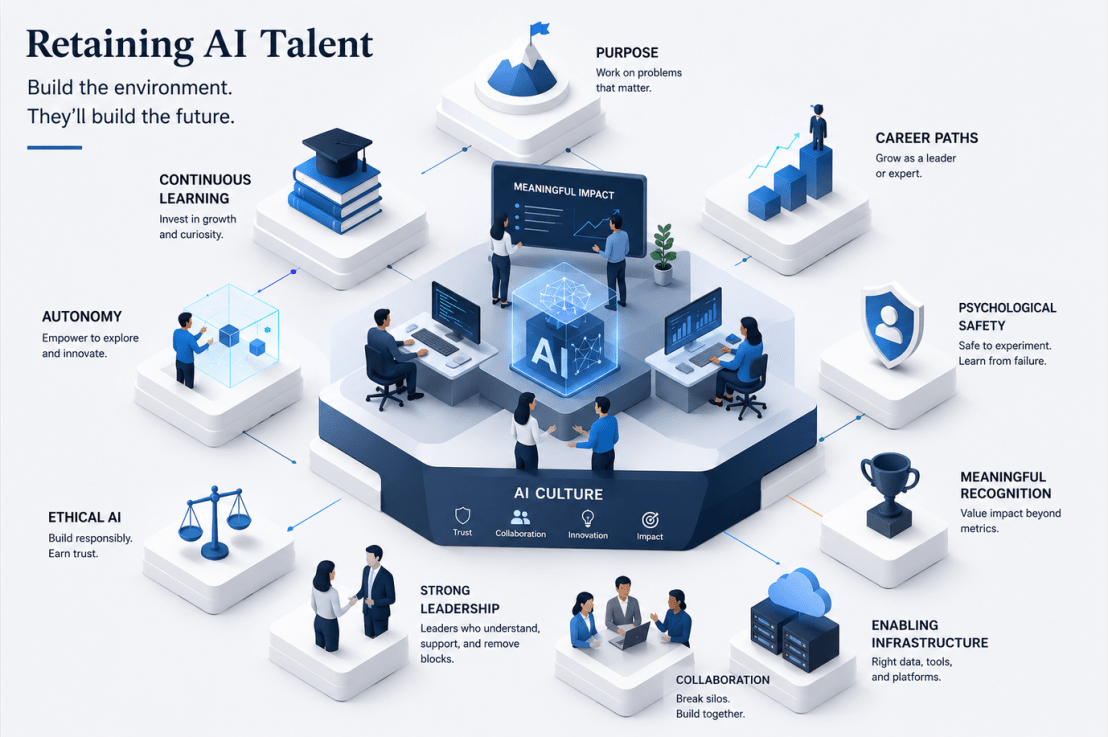
The AI Retention Challenge Is Unlike Any Before
Artificial intelligence has become a strategic priority for organizations across industries. Enterprises are investing heavily in generative AI, machine learning, predictive analytics, and intelligent automation to transform products, services, and business processes. Yet despite these investments, one of the greatest challenges organizations face is not developing AI technologies but retaining the professionals who build and deploy them. Skilled AI practitioners—including machine learning engineers, data scientists, AI researchers, MLOps specialists, and AI product managers—are among the most sought-after professionals in the global labor market. Their expertise is scarce, demand continues to rise, and attractive opportunities exist across technology firms, consulting organizations, financial institutions, healthcare providers, manufacturing companies, and startups.
Many organizations still assume that competitive salaries and attractive benefits are sufficient to retain AI professionals. While compensation remains important, it has increasingly become a baseline expectation rather than a decisive factor. AI professionals are driven by intellectual curiosity, continuous learning, meaningful work, and opportunities to solve complex problems. They seek organizations that challenge them technically while providing opportunities to shape strategic decisions and generate tangible business value. Consequently, retaining AI talent requires organizations to rethink traditional human resource practices and instead create an innovation ecosystem that continuously engages technical professionals. Organizations that recognize retention as a strategic capability rather than merely an administrative responsibility will possess a significant competitive advantage in the emerging AI economy.
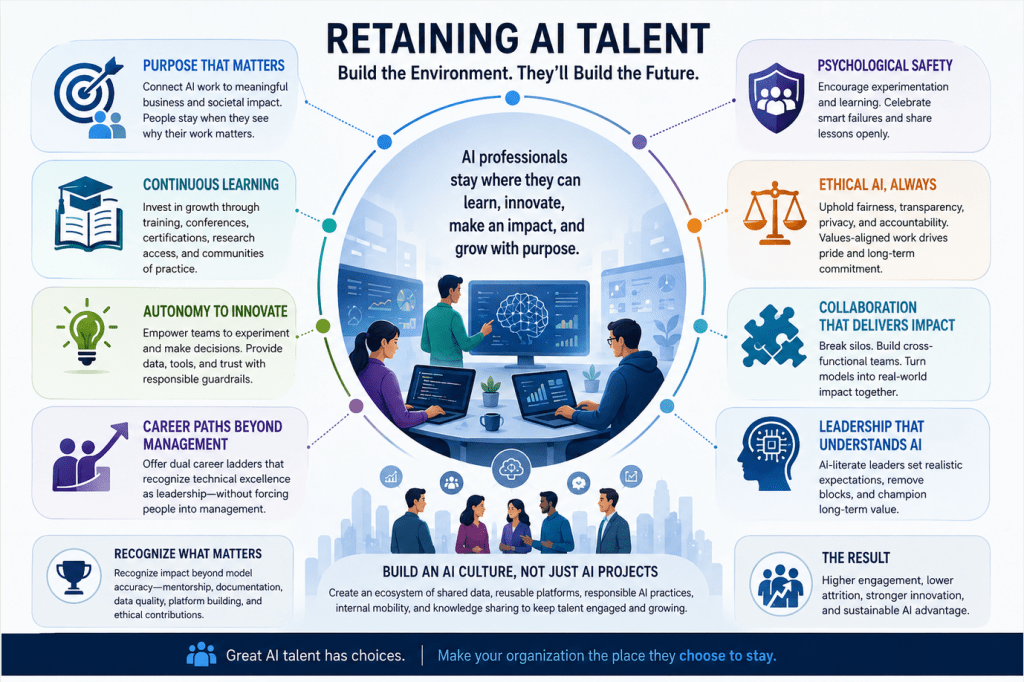
Purpose Creates Long-Term Commitment
One distinguishing characteristic of AI professionals is their strong desire to solve meaningful problems. Unlike routine technical work, artificial intelligence involves designing intelligent systems capable of transforming organizational performance and societal outcomes. Consequently, employees are far more committed when they understand how their work contributes to broader organizational missions.
Purpose has become a powerful retention mechanism because AI professionals increasingly seek opportunities where technology creates measurable impact rather than merely improving operational efficiency. A data scientist developing predictive healthcare models, for example, may derive greater satisfaction from improving patient outcomes than from marginally increasing advertising conversion rates. Similarly, engineers building sustainability solutions or fraud detection systems often perceive greater value in projects with visible societal benefits.
Leaders therefore need to communicate how individual AI initiatives contribute to organizational strategy, customer value, and long-term societal outcomes. When employees understand the significance of their contributions, their work becomes personally meaningful rather than simply professionally rewarding. Organizations capable of consistently linking technical innovation with organizational purpose are substantially more successful in retaining highly skilled AI professionals.
Continuous Learning Has Become the Most Valuable Employee Benefit
Artificial intelligence evolves at an extraordinary pace. New foundation models, neural network architectures, programming frameworks, and development tools emerge continuously, making today’s expertise vulnerable to rapid obsolescence. Consequently, AI professionals evaluate employers based not only on present opportunities but also on their ability to support future career development.
Organizations that encourage continuous learning create environments where employees remain intellectually stimulated while expanding their professional capabilities. Instead of treating learning as an occasional training activity, successful organizations integrate it into everyday work. Employees receive opportunities to experiment with emerging technologies, participate in research collaborations, attend international conferences, publish technical papers, and contribute to open-source communities. Internal knowledge-sharing sessions, AI communities of practice, and cross-functional learning initiatives further strengthen organizational capability while satisfying employees’ desire for professional growth.
Continuous learning serves a dual purpose. It enables organizations to remain technologically competitive while simultaneously providing employees with confidence that their skills will remain relevant in an increasingly dynamic labor market. Organizations that neglect professional development often discover that employees seek learning opportunities elsewhere, even when compensation remains attractive.
Autonomy Drives Innovation and Retention
Innovation thrives in environments where employees possess sufficient autonomy to explore new ideas. Unfortunately, many organizations unintentionally create bureaucratic structures that constrain experimentation through excessive approvals, rigid procedures, limited access to data, or restrictive governance mechanisms. Such environments discourage creativity and reduce employee satisfaction.
AI professionals generally value independence because experimentation lies at the heart of successful model development. Developing intelligent systems requires iterative testing, continuous refinement, and exploration of alternative approaches. Organizations that provide controlled freedom encourage greater creativity while accelerating innovation.
This autonomy should not be confused with the absence of governance. Rather, effective organizations establish governance frameworks that protect privacy, fairness, and security while allowing technical teams flexibility in choosing modeling approaches and development strategies. Employees who experience trust and empowerment develop stronger psychological ownership of their work, increasing both engagement and organizational commitment.
Career Development Must Extend Beyond Management
Traditional organizational structures frequently assume that career progression requires moving into supervisory or managerial positions. This assumption creates an unintended dilemma for highly skilled AI professionals, many of whom prefer solving technical problems rather than managing people.
Organizations that successfully retain AI talent recognize that technical excellence deserves recognition equal to managerial leadership. Dual career pathways enable employees to pursue advanced technical careers without sacrificing compensation, prestige, or organizational influence. Distinguished engineers, principal scientists, AI architects, and research fellows should enjoy career progression comparable to senior executives.
Such career structures communicate that technical expertise represents a strategic organizational asset rather than merely an intermediate step toward management. Employees who can envision long-term professional growth without abandoning their technical interests are considerably less likely to pursue external opportunities.
Psychological Safety Encourages Innovation
Artificial intelligence development is inherently experimental. Models frequently fail to converge, datasets contain unexpected limitations, algorithms generate inaccurate predictions, and deployment environments introduce unforeseen challenges. Failure therefore constitutes an inevitable component of innovation.
Organizations that punish unsuccessful experimentation unintentionally discourage creativity and reduce employee motivation. In contrast, psychologically safe environments encourage employees to explore ambitious ideas without fear of professional consequences. Leaders who frame unsuccessful experiments as valuable learning opportunities foster cultures where innovation becomes sustainable.
Knowledge-sharing sessions, post-project reflections, technical demonstrations, and collaborative problem-solving further reinforce collective learning. Employees become more willing to exchange ideas openly, seek assistance when necessary, and pursue innovative solutions. Such environments not only improve technical outcomes but also strengthen organizational commitment by creating cultures of trust and collaboration.
Ethical AI Strengthens Organizational Loyalty
Ethics has become an increasingly important consideration for AI professionals. Many practitioners carefully evaluate whether potential employers demonstrate responsible approaches to fairness, transparency, privacy, and accountability. Organizations perceived as neglecting ethical responsibilities often struggle to attract and retain highly qualified employees.
Responsible AI practices provide employees with confidence that their work contributes positively to society while minimizing unintended consequences. Transparent governance frameworks, bias detection procedures, explainable AI methodologies, human oversight mechanisms, and continuous monitoring reinforce professional integrity.
Employees are more likely to remain with organizations whose values align with their own professional principles. Ethical leadership therefore functions not merely as regulatory compliance but also as an important mechanism for employee retention.
Collaboration Creates Visible Impact
Artificial intelligence rarely delivers organizational value through technical excellence alone. Successful implementation requires collaboration among engineers, business leaders, legal experts, cybersecurity professionals, designers, operations specialists, and domain experts. Unfortunately, organizational silos often prevent promising AI solutions from progressing beyond prototype stages.
AI professionals become increasingly frustrated when innovative models remain unused because of poor coordination, insufficient infrastructure, or organizational resistance. Consequently, organizations should establish multidisciplinary teams where technical and business professionals collaborate throughout the complete innovation lifecycle.
When employees witness their models improving business performance, enhancing customer experiences, or transforming organizational processes, they experience greater satisfaction and stronger professional identity. Visible impact reinforces the connection between individual effort and organizational success, strengthening long-term commitment.
Leadership Determines Whether AI Professionals Stay
One frequently overlooked determinant of retention is managerial capability. Technical professionals often become dissatisfied when leaders possess limited understanding of AI development processes. Unrealistic project schedules, poorly defined objectives, rapidly changing priorities, and excessive emphasis on short-term outcomes create unnecessary frustration.
Effective AI leadership does not require executives to become machine learning experts. However, leaders should understand the iterative nature of AI development, the importance of high-quality data, the complexity of model validation, and the challenges associated with deployment and governance. Such understanding enables realistic planning while fostering mutual respect between technical and managerial communities.
AI-literate leadership also improves communication between executives and technical teams, ensuring that strategic objectives align with technological realities. Employees are significantly more likely to remain with organizations where leadership demonstrates genuine appreciation for the complexity and strategic importance of AI work.
Building an AI Culture Rather Than Isolated AI Projects
Organizations frequently treat artificial intelligence as a collection of independent initiatives aimed at solving individual business problems. While such projects may generate short-term benefits, they rarely create environments capable of retaining exceptional talent. Sustainable retention emerges when organizations cultivate AI as an enduring organizational capability rather than a temporary technological investment.
An AI-oriented culture encourages continuous experimentation, interdisciplinary collaboration, enterprise-wide knowledge sharing, reusable machine learning infrastructure, responsible governance, and internal mobility across innovative projects. Employees working within mature AI ecosystems encounter diverse technical challenges without leaving the organization, enabling continuous professional growth while preserving institutional knowledge.
Such cultures transform retention from an outcome of human resource policies into a consequence of organizational design. Employees remain because the organization continuously offers opportunities for learning, innovation, collaboration, and meaningful contribution.
Conclusion: Retention Is the Foundation of Sustainable AI Advantage
As artificial intelligence reshapes industries, retaining talented professionals has become as important as acquiring them. Organizations that rely solely on financial incentives will increasingly struggle to compete in a marketplace where intellectual fulfillment, continuous learning, meaningful work, and ethical responsibility strongly influence career decisions. AI professionals seek environments that challenge them technically, empower them creatively, recognize their expertise, and enable them to create lasting organizational impact.
The organizations that succeed in the coming decade will be those that view AI talent not merely as employees but as long-term strategic partners in innovation. By creating cultures centered on purpose, autonomy, continuous learning, responsible governance, collaborative innovation, and technically informed leadership, organizations can build workplaces where exceptional AI professionals choose not only to work but to remain. Ultimately, the sustainable competitive advantage in artificial intelligence will belong not to organizations possessing the most sophisticated algorithms, but to those capable of retaining the people who continuously imagine, improve, and responsibly deploy them.


