
A strong complementary framework to Herzberg for motivating young employees in technology firms is Self-Determination Theory (SDT). Developed by psychologists Edward Deci and Richard Ryan, SDT explains motivation through three fundamental psychological needs: autonomy, competence, and relatedness. These three needs are particularly relevant in technology organizations, where employees often work on complex problems, collaborate digitally, learn continuously, and expect considerable independence in how they perform their jobs.
Beyond Salary: How to Motivate Young Employees in Technology Firms
Technology companies have spent years experimenting with ways to motivate young employees. Higher salaries, bonuses, flexible working, free meals, gaming rooms, hybrid work, learning subscriptions, and employee wellness programs have all become familiar features of the modern technology workplace. Yet organizations often discover that these incentives do not automatically translate into sustained engagement. The problem may be that organizations are focusing on what employees receive rather than what employees experience while doing their work. This is where Self-Determination Theory provides a useful perspective. SDT proposes that people are more likely to experience high-quality motivation when three basic psychological needs are fulfilled: autonomy, competence, and relatedness. For young employees in technology firms, these needs can fundamentally shape whether a job feels like merely a source of income or an environment in which they can develop, contribute, and grow.
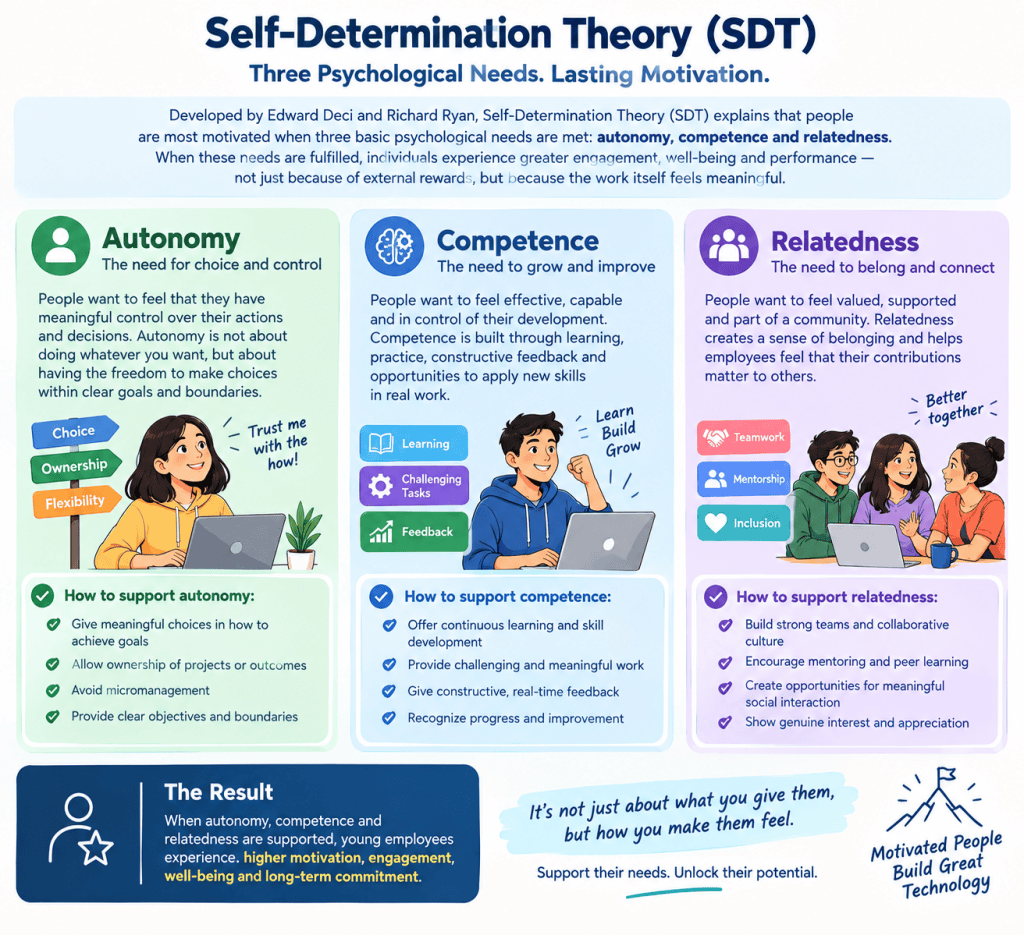
Autonomy: Give Young Employees Room to Decide
The first psychological need is autonomy—the feeling that one has meaningful control over one’s actions and decisions. Technology firms are often built around innovation and problem solving, yet their management practices can sometimes contradict this philosophy. A young software engineer may be hired because of technical expertise but then be given highly prescriptive instructions about how every task should be completed. A product manager may be responsible for a product outcome but have little influence over the decisions required to achieve it. Such environments can gradually weaken motivation.
Autonomy does not mean allowing employees to do whatever they want. It means providing choice within clearly defined organizational objectives. Instead of telling a developer exactly how to solve a problem, a manager can define the desired outcome, constraints, deadlines, and quality standards while allowing the employee to determine the technical approach. Similarly, managers can allow employees to select projects, experiment with tools, propose alternative solutions, or determine how they organize their work. For young technology professionals, this can be especially powerful because it communicates trust. The managerial question therefore changes from “How do I make this employee follow my instructions?” to “How can I create the conditions in which this employee can own the problem?”
Competence: Create a Workplace Where People Can Become Better
The second need is competence—the feeling that one is capable, effective, and developing mastery. This is particularly important in technology because skills can become obsolete rapidly. Programming languages, cloud platforms, AI tools, cybersecurity techniques, analytics methods, and development architectures are constantly evolving. A young employee who believes that the organization is helping them build valuable capabilities can perceive the workplace as an environment for professional growth. But competence requires more than training programs. Employees need opportunities to apply what they learn. A company may provide an AI course, for example, but the motivational value increases substantially when employees subsequently receive an opportunity to use AI in a real project. Similarly, a junior developer may learn a new architecture more effectively when entrusted with a manageable component of an actual product.
Managers can therefore create competence by combining learning with progressively challenging assignments. Feedback also becomes important. Effective feedback should tell employees not merely whether they succeeded, but how they can become better. A young employee who receives constructive feedback after a difficult project can interpret failure as part of the learning process rather than as evidence of personal inadequacy. This creates a culture in which employees are encouraged to experiment, learn, and improve.
Relatedness: Technology Is Still a Human Business
The third psychological need is relatedness—the feeling of belonging, connection, and being valued by others. This need can easily be overlooked in technology organizations. Remote work, distributed teams, digital collaboration platforms, and AI-assisted workflows can make work highly efficient, but efficiency does not automatically create connection. Young employees need to feel that they belong to a team and that their contributions matter to people around them.
Managers can strengthen relatedness through mentoring, peer learning, collaborative problem solving, team rituals, and meaningful interpersonal interaction. A young employee who has a senior colleague willing to provide guidance may feel considerably more connected to the organization than someone who interacts primarily with project-management software and automated systems. Importantly, relatedness does not require constant socializing. It is about meaningful connection, not simply more meetings. A manager asking, “How can I help you succeed?” can sometimes create more connection than another team-building event.
The Technology Manager’s Motivation Equation
SDT suggests that organizations should think about motivation as an interaction between the employee and the work environment.
Autonomy answers: Do I have meaningful control over how I work?
Competence answers: Am I becoming better at something valuable?
Relatedness answers: Do I belong here, and do my contributions matter to others?
When these three needs are supported simultaneously, young employees can develop a stronger form of motivation that is not entirely dependent on external rewards. Consider a young data scientist working for a technology company. The organization gives her ownership of a customer analytics problem rather than prescribing every analytical step. She receives access to advanced tools and mentoring that help her develop new capabilities. Her manager regularly discusses how her model is influencing business decisions, while colleagues involve her in technical discussions. Her motivation is being supported on all three dimensions. She has autonomy through ownership, competence through learning and mastery, and relatedness through recognition and collaboration.
From Employee Management to Motivation Design
The deeper lesson of Self-Determination Theory is that motivation should not be treated as something managers simply give employees. Instead, managers can design environments in which motivation can flourish. For technology firms employing large numbers of young professionals, this means moving beyond the assumption that motivation can be purchased through compensation and perks. Competitive salaries remain important, but they establish the foundation rather than completing the motivational equation. The more fundamental challenge is designing work that provides choice, learning, and connection.
A young technology employee does not necessarily need a manager who constantly pushes them harder. They may need a manager who creates the conditions in which they want to push themselves. That is the central insight of Self-Determination Theory: when people experience autonomy, develop competence, and feel connected to others, motivation increasingly comes from the work itself rather than merely from the rewards attached to it. For technology firms competing not only for talent but also for employees’ sustained commitment, that distinction can become strategically important.


