
MBA interviews in India are designed to assess much more than academic knowledge or the ability to answer conventional questions. Whether the interview is for admission to an IIM, an IIT management programme, a leading private B-school, or a specialized MBA programme, interviewers often want to understand how a candidate has behaved in real situations. Questions such as “Tell me about a time when you demonstrated leadership,” “Describe a conflict you faced,” “Give me an example of a failure,” or “Tell us about a difficult decision you made” are behavioral questions. They require candidates to move beyond theoretical answers and demonstrate their capabilities through evidence from their own experiences.
The STAR method provides a simple but powerful structure for answering such questions. STAR stands for Situation, Task, Action, and Result. It helps candidates convert an experience from their academic, professional, internship, entrepreneurial, extracurricular, or personal life into a concise and logically organized story. For MBA aspirants, mastering this framework can significantly improve the clarity, credibility, and effectiveness of interview responses.
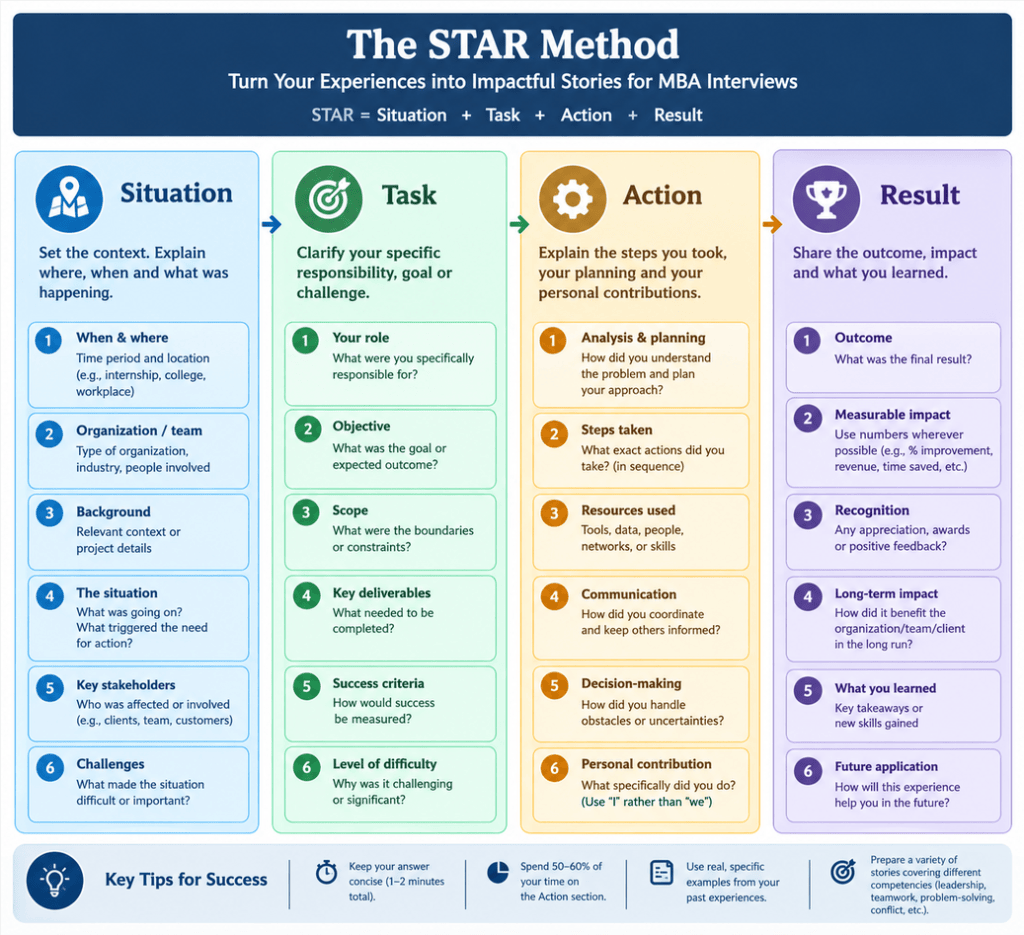
The first component is Situation. Here, the candidate establishes the context of the story. The interviewer needs enough information to understand what was happening, but the explanation should not become unnecessarily long. A good Situation statement identifies the setting, the relevant people or team, the nature of the organization or project, and the problem that emerged. For example, a candidate could explain that during an internship at a technology company, a project team was struggling to complete a client deliverable because information was scattered across several departments. The objective is to create a context in which the candidate’s subsequent responsibility becomes meaningful.
The second component is Task. This explains what the candidate was specifically expected to accomplish. The distinction between Situation and Task is important. The Situation describes the broader circumstances, while the Task identifies the candidate’s particular responsibility, objective, or challenge. An MBA interviewer is interested not simply in what happened to a candidate but in what the candidate was expected to do about it. For example, the candidate might explain that the project manager asked them to coordinate information from three departments and prepare a consolidated report within five days. This immediately establishes ownership and accountability.
The third component, Action, is the most important part of the STAR response. Candidates should explain exactly what they personally did. This is where many interview responses become weak. Instead of describing individual contributions, candidates often say, “We discussed the problem and solved it as a team.” Such an answer gives the interviewer little evidence about the candidate’s own capabilities.
A strong Action section describes the candidate’s reasoning, planning, communication, decision-making, and execution. In the example above, the candidate might explain how they identified the information gaps, created a common data template, contacted representatives from the three departments, established daily follow-ups, prioritized critical information, and used the consolidated data to identify inconsistencies before submission. The candidate should use “I” when describing personal contributions rather than repeatedly using “we.”
For MBA interviews, the Action component is particularly valuable because it can demonstrate competencies that business schools frequently seek: leadership, analytical thinking, teamwork, communication, initiative, problem-solving, adaptability, negotiation, and decision-making. Ideally, around 50% to 60% of the response should focus on Action. This allows the interviewer to understand not only what the candidate did but also why particular decisions were made.
The final component is Result. The candidate should explain what happened because of the actions taken. Whenever possible, results should be quantified. Numbers make an answer more concrete and credible. Instead of saying, “The project was completed successfully,” a stronger answer would be, “The report was submitted two days ahead of the deadline, reduced reconciliation errors by approximately 30%, and was subsequently adopted as the team’s standard reporting format.” If the result cannot be expressed numerically, candidates can describe other tangible outcomes, such as receiving recognition, improving a process, resolving a conflict, winning a competition, retaining a client, or successfully completing a difficult assignment.
The Result section can also include what the candidate learned. This is particularly useful when answering questions about failure, conflict, mistakes, or difficult experiences. An MBA interviewer may be interested not only in whether a candidate succeeded but also in whether the experience changed the candidate’s approach to future situations.
For Indian MBA interviews, candidates should build a personal library of STAR stories before the interview. These stories can come from internships, employment, college projects, academic competitions, student clubs, sports, volunteering, entrepreneurship, family businesses, or other meaningful experiences. Candidates should prepare examples covering leadership, teamwork, conflict, failure, achievement, ethical dilemmas, initiative, problem-solving, handling pressure, adapting to change, and influencing others.
However, preparing memorized speeches is not the objective. Interviewers may ask follow-up questions such as “Why did you choose that approach?”, “What would you do differently?”, “What was your personal contribution?”, or “What did your teammate think?” Therefore, candidates should understand their stories deeply rather than memorize exact sentences.
A useful STAR answer should generally fit within one to two minutes. The candidate should provide sufficient context without spending most of the response describing the background. A practical structure is approximately 15–20% for Situation, 10–15% for Task, 50–60% for Action, and 15–20% for Result and learning.
Ultimately, the STAR method is not merely an interview technique. It is a way of presenting evidence of managerial potential. Instead of claiming, “I am a good leader,” a candidate demonstrates leadership through a specific experience. Instead of saying, “I am good at solving problems,” the candidate explains a problem, the decisions made, the actions taken, and the resulting impact. For MBA aspirants in India, this distinction can make behavioral interview answers substantially more convincing.
The strongest STAR responses therefore follow one fundamental principle: do not tell the interviewer what qualities you possess; show those qualities through evidence from your experiences. A well-structured story gives the interviewer a clear understanding of the situation, your responsibility, your personal contribution, and the outcome. When practiced with authentic examples and delivered naturally, STAR can turn ordinary experiences into compelling evidence of readiness for management education.


