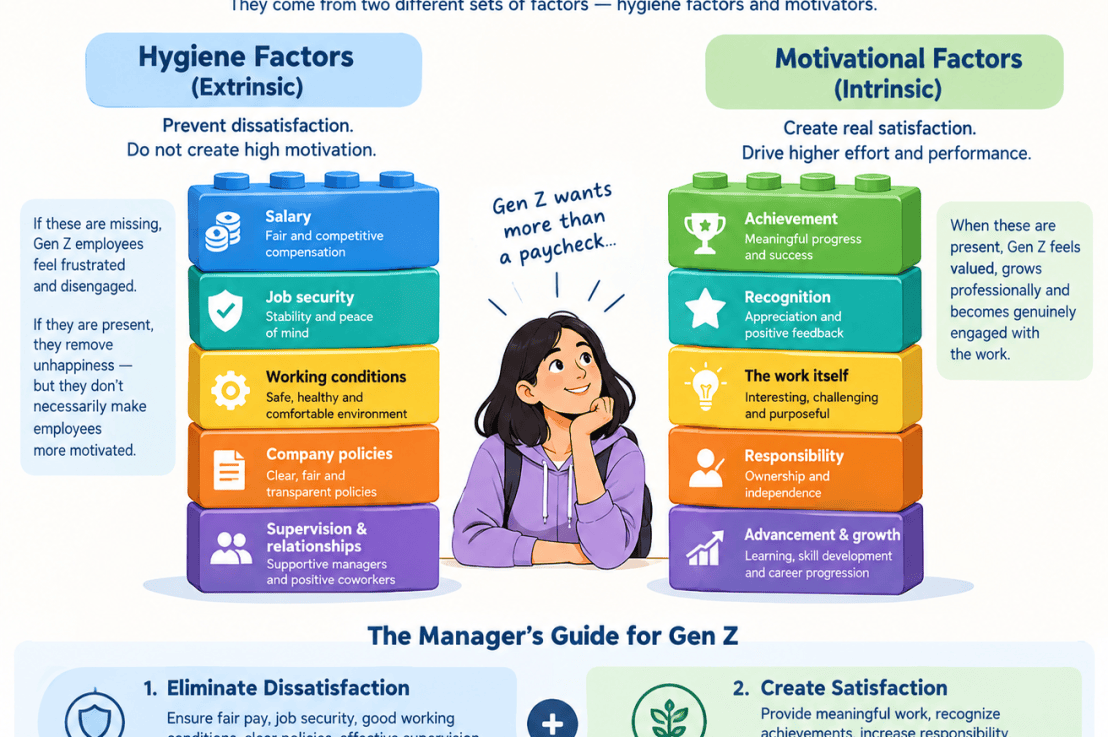
The workplace has changed dramatically, but one question remains remarkably persistent: How do you motivate employees to perform at their best? For organizations managing Generation Z employees, the question has become even more important. Gen Z has entered the workforce with expectations shaped by digital technology, rapid feedback, greater emphasis on flexibility, and a desire for meaningful work. Yet many managers continue to approach motivation primarily through salary increases, perks, bonuses, and promotions. These incentives matter—but they may not be enough.
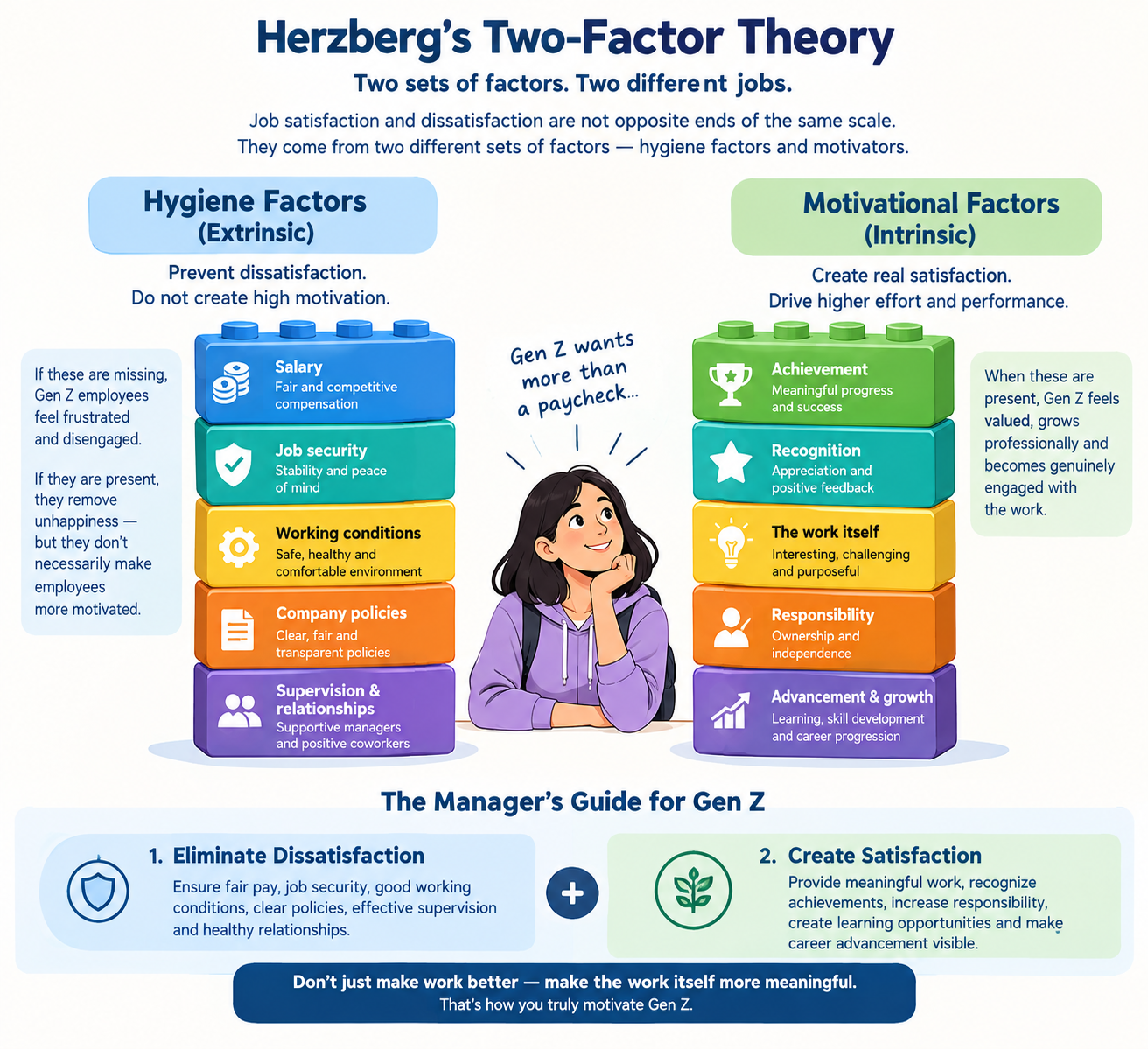
A useful framework for understanding this problem comes from psychologist Frederick Herzberg’s Two-Factor Theory, introduced in 1959. Based on interviews with 200 engineers and accountants, Herzberg argued that job satisfaction and job dissatisfaction are not simply opposite ends of the same continuum. Instead, they arise from two different sets of factors: hygiene factors and motivational factors.
This distinction has important implications for organizations trying to engage Gen Z employees.
Salary Can Prevent Dissatisfaction—but May Not Create Motivation
Herzberg classified salary, job security, working conditions, company policies, supervision, and relationships with coworkers as hygiene factors. These are the basic conditions employees expect from a workplace. Consider salary. If a Gen Z employee believes that compensation is unfair or inadequate, dissatisfaction is likely to emerge. Similarly, an unsafe workplace, poor management, unclear policies, unstable employment, or toxic relationships with colleagues can quickly undermine engagement. But improving these factors does not necessarily create extraordinary motivation.
An employee may receive a salary increase and feel relieved, but that does not automatically mean the employee will become more passionate about the job. Likewise, providing attractive office facilities or flexible working arrangements can eliminate sources of frustration without necessarily creating enthusiasm for the work itself. This is particularly relevant for Gen Z. Organizations may invest heavily in perks such as free meals, gaming areas, wellness programs, hybrid-work options, or financial incentives. These initiatives can be valuable, but managers should recognize what they primarily accomplish: they improve the conditions surrounding work rather than necessarily making the work itself more motivating. The implication is straightforward: first remove the sources of dissatisfaction, but do not mistake this for employee motivation.
Gen Z Wants More Than a Paycheck
The second part of Herzberg’s theory focuses on motivational factors. These include achievement, recognition, the work itself, responsibility, advancement, and personal growth. These factors are intrinsic to the job. When employees experience them, they can generate genuine satisfaction and encourage greater effort. For Gen Z employees, this distinction can be particularly useful. Many younger employees want to understand why their work matters, how their contribution creates value, and where their career is heading. They may expect faster feedback and opportunities to learn rather than waiting several years for a formal annual appraisal. Imagine two employees receiving exactly the same salary. One spends most of the day performing repetitive tasks with little autonomy and rarely receives feedback. The other is given responsibility for a meaningful project, receives recognition for good work, learns new skills, and can see a potential career path within the organization. Their compensation may be identical, but their motivational experiences are fundamentally different. The second employee is experiencing Herzberg’s motivators.
Recognition Matters
Recognition is especially important in managing younger employees. Recognition does not necessarily mean expensive rewards. A manager acknowledging a specific contribution, publicly appreciating an achievement, or explaining how an employee’s work affected a project’s outcome can create a sense of accomplishment. The key is specificity. “Good job” provides limited information. “Your analysis helped us identify the customer segment responsible for 30% of the new revenue opportunity” connects recognition with achievement and impact. For Gen Z employees accustomed to rapid digital feedback, organizations may also need to reconsider the traditional annual-review model. Frequent developmental conversations can help employees understand what they are doing well, where they can improve, and what opportunities might come next.
Give Gen Z Employees Ownership
Responsibility is another powerful motivator. Managers sometimes attempt to motivate young employees by giving them instructions and closely monitoring execution. Herzberg’s framework suggests another approach: give employees meaningful ownership of outcomes. Instead of saying, “Complete this task,” a manager might say, “Here is the problem we need to solve. You own the solution, and I will support you.” That shift can transform the psychological experience of work. Employees move from being task executors to problem owners. Growth is equally important. Gen Z employees may be willing to work hard, but they also want to know whether today’s work is building tomorrow’s capabilities. Organizations can respond through mentoring, skill development, challenging assignments, internal mobility, and transparent career pathways.
The Manager’s Motivation Checklist
Herzberg’s theory therefore suggests a two-stage approach to managing Gen Z employees.
First, eliminate dissatisfaction. Ensure fair compensation, job security, reasonable working conditions, effective policies, competent supervision, and healthy workplace relationships. Then create satisfaction. Provide meaningful work, recognize achievement, increase responsibility, create opportunities for learning, and make career advancement visible. The critical insight is that these are not substitutes for one another. A great salary cannot compensate indefinitely for meaningless work. A challenging assignment cannot compensate for an unfair workplace. Flexible working arrangements cannot replace recognition. And free coffee cannot substitute for career growth.
For organizations trying to motivate Gen Z, perhaps the most important lesson from Herzberg is therefore simple: don’t just make work better—make the work itself more meaningful.
Motivation begins when employees stop asking, “What am I getting for doing this job?” and increasingly begin to feel, “What can I achieve by doing it?”


