Social media has become an integral part of modern professional and personal life. It helps us learn, network, promote ideas, follow industries, maintain relationships, and discover opportunities. Yet the same platforms that create value can quietly consume hours of the day. The problem is rarely the five minutes spent checking Instagram, LinkedIn, YouTube, or X. It is the twenty-five minutes that follows because one post leads to another, one video triggers another recommendation, and one notification becomes an extended browsing session.
The challenge, therefore, is not to eliminate social media. It is to prevent intentional use from turning into unintentional consumption.
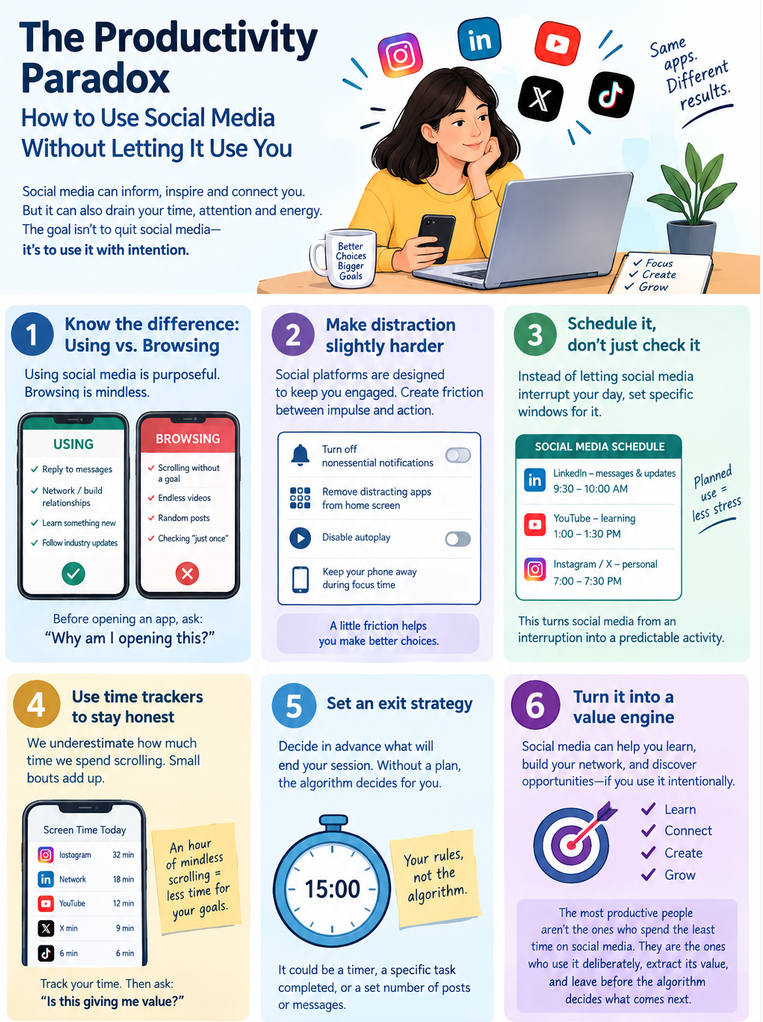
The first step is to distinguish between using social media and browsing social media. These activities may look identical on a smartphone but have very different productivity consequences. Opening LinkedIn to respond to a professional message is purposeful. Opening LinkedIn without a specific objective and scrolling until something interesting appears is consumption. Watching a tutorial on YouTube is purposeful learning; watching recommended videos for an hour after the tutorial is distraction disguised as learning.
This distinction creates an important productivity principle: Before opening a platform, define the purpose.
A simple question—“Why am I opening this app?”—can be surprisingly powerful. If the answer is unclear, postponing the activity may be the better decision. If the objective is clear, set a boundary around it. “I will spend 15 minutes responding to messages” is fundamentally different from “I will check LinkedIn.”
The second principle is to make distraction slightly harder. Social-media platforms are designed to reduce friction. Notifications, infinite scrolling, personalized recommendations, autoplay, and algorithmically selected content encourage users to remain engaged. Productivity requires reversing some of that design.
Turn off nonessential notifications. Remove distracting applications from the home screen. Log out of platforms that routinely trigger excessive browsing. Disable autoplay where possible. Keep the phone away during periods of concentrated work. None of these actions requires extraordinary discipline. They simply create a small amount of friction between impulse and action.
That friction matters because many social-media sessions are triggered automatically rather than deliberately. A notification appears, the phone is picked up, and the user enters an entirely different cognitive environment. What began as a two-second interruption can become a thirty-minute diversion.
The third principle is to schedule social media rather than continuously checking it. Instead of allowing platforms to interrupt the workday, create designated windows for them. A professional might check LinkedIn in the morning and late afternoon, respond to messages during a defined period, and reserve entertainment-oriented browsing for a specific period in the evening.
This approach changes social media from an interruption into a scheduled activity. It also reduces the cognitive burden of repeatedly deciding whether to check the phone. The objective is not perfect abstinence; it is predictable usage.
The Pomodoro principle can reinforce this approach. During a focused work interval, social media is off-limits. During the break, a brief check may be acceptable—but only within the boundaries of the break. The timer creates a psychological boundary between focused work and digital consumption.
The fourth principle is to measure time spent rather than merely intentions. Most people underestimate how much time they spend scrolling because social-media consumption occurs in small fragments. Ten minutes in the morning, fifteen minutes after lunch, twenty minutes during an evening break, and another fifteen minutes before bed can easily become an hour or more.
Screen-time reports provide a useful reality check. The objective should not necessarily be to minimize the number. Instead, ask whether the time is producing sufficient value. If an hour of LinkedIn generates meaningful professional connections, learning, or opportunities, it has a different value proposition from an hour of algorithmic scrolling that leaves little behind.
Finally, productive social-media use requires an exit strategy. Before beginning a session, decide what will cause it to end. It might be a timer, completion of a specific task, or a predetermined number of posts or messages. Without an exit condition, the platform’s algorithm effectively decides when the session ends.
The deeper lesson is that digital productivity is not about having unlimited self-control. It is about designing an environment in which good decisions become easier. Social media can be a powerful professional and personal resource, but its value depends on whether we control the purpose, duration, and context of our use.
The most productive person is not necessarily the one who spends the least time on social media. It may be the person who can use it deliberately, extract its value, and leave before the algorithm decides what comes next.


