Introduction
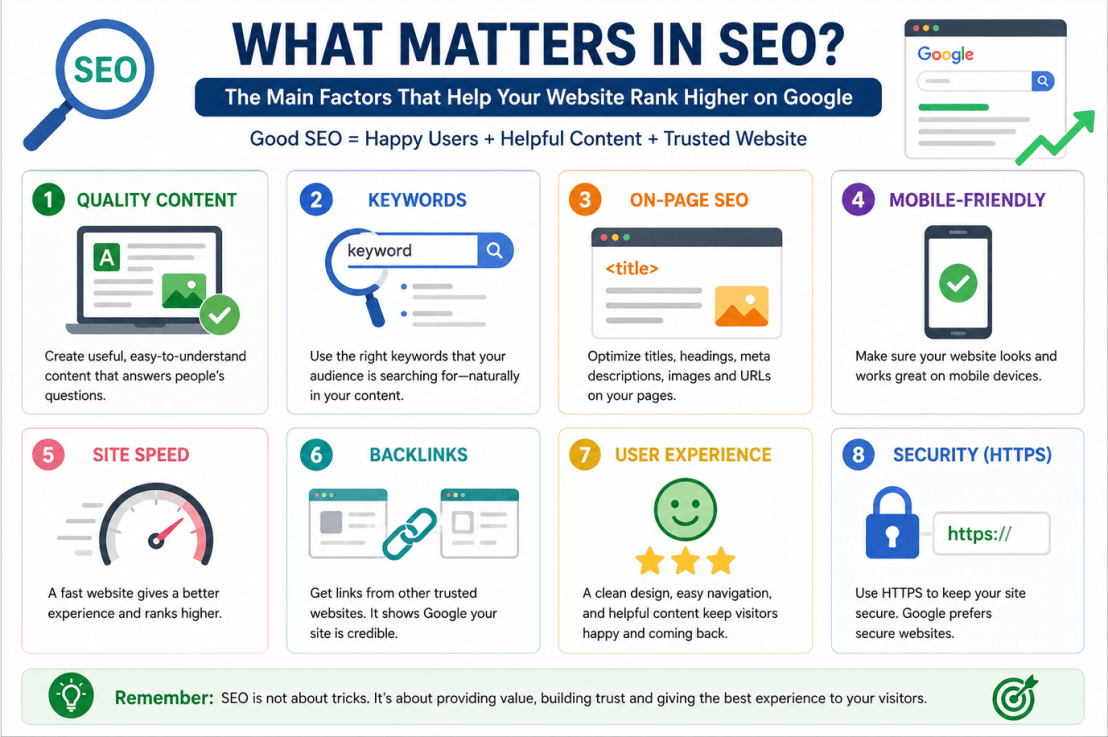
Search Engine Optimization (SEO) has undergone a remarkable transformation since the early days of keyword stuffing and backlink accumulation. Traditionally, SEO revolved around optimizing websites to rank higher in search engine results pages (SERPs) by aligning content with search engine algorithms. However, the rapid advancement of Generative Artificial Intelligence (Generative AI) has fundamentally reshaped how information is created, discovered, interpreted, and presented. Search engines are no longer merely indexing web pages; they are increasingly synthesizing information and directly answering user queries through AI-generated summaries, conversational interfaces, and multimodal search experiences. Consequently, organizations, marketers, and content creators must rethink conventional SEO strategies to remain visible in an increasingly AI-mediated search ecosystem.
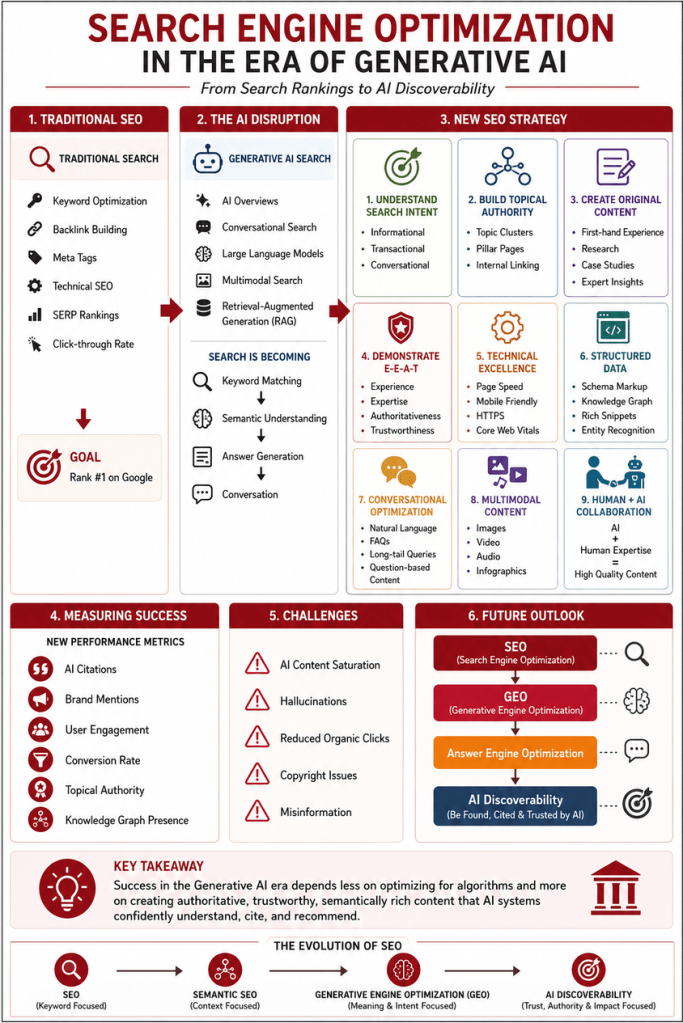
The emergence of large language models (LLMs), retrieval-augmented generation (RAG), semantic search, and AI-powered search assistants has shifted the emphasis from keyword optimization to contextual relevance, topical authority, user intent, and content trustworthiness. Rather than competing solely for rankings, businesses must now optimize for AI discoverability, credibility, and citation within generative search experiences. This evolving landscape has given rise to Generative Engine Optimization (GEO), representing the next evolutionary stage of digital visibility.
Evolution of Search in the Generative AI Era
Modern search engines increasingly employ transformer-based language models to understand user intent rather than relying solely on keyword matching. Systems such as AI-generated search overviews, conversational search assistants, and multimodal search capabilities enable users to receive synthesized responses without necessarily visiting multiple websites. Users can ask complex, conversational, and context-rich questions, expecting comprehensive and personalized answers.
This transformation changes the objective of SEO from maximizing clicks to maximizing inclusion within AI-generated responses. Content must therefore satisfy both traditional ranking algorithms and AI models that evaluate semantic quality, factual consistency, contextual completeness, and authoritative sourcing.
Furthermore, search journeys are becoming increasingly nonlinear. Users frequently refine queries through follow-up questions, making conversational optimization an important component of modern SEO strategy.
From Keywords to Search Intent
Keyword optimization remains relevant but is no longer sufficient. Generative AI excels at understanding semantic relationships among concepts, allowing search systems to recognize meaning even when exact keywords are absent.
Consequently, SEO professionals must prioritize search intent over keyword density. Search intent generally falls into four categories:
- Informational intent
- Navigational intent
- Transactional intent
- Commercial investigation
Content should comprehensively address the underlying information need rather than merely incorporating target keywords repeatedly. AI systems reward documents that provide complete, logically structured, and contextually rich explanations.
Topic clusters have therefore become increasingly important. Instead of creating isolated pages targeting individual keywords, organizations should build interconnected knowledge hubs that demonstrate expertise across related subjects. Such topical authority improves both traditional rankings and AI confidence in recommending content.
High-Quality Content as the Primary Ranking Signal
Generative AI has significantly raised expectations regarding content quality. Since AI systems can generate generic articles rapidly, search engines increasingly differentiate valuable human-created content from mass-produced, low-value material.
Effective SEO now emphasizes:
- Original research
- First-hand experience
- Expert insights
- Case studies
- Statistical evidence
- Practical recommendations
- Unique perspectives
Content that merely repeats information available elsewhere offers limited value and is unlikely to be prominently featured in AI-generated responses.
The concept of information gain has become increasingly important. Search engines reward content that contributes new knowledge rather than reproducing existing material. Organizations should therefore invest in proprietary research, customer insights, industry reports, interviews, and expert commentary.
E-E-A-T and Trustworthiness
One of the most influential frameworks in contemporary SEO is Experience, Expertise, Authoritativeness, and Trustworthiness (E-E-A-T). Generative AI has amplified the importance of these quality signals because AI-generated summaries require highly reliable source material.
Websites should clearly demonstrate:
- Author credentials
- Institutional expertise
- Accurate citations
- Transparent editorial policies
- Updated information
- Reliable references
Building organizational credibility has become as important as optimizing technical website elements. High-authority domains are more likely to be cited within AI-generated search summaries, increasing brand visibility even when users do not directly visit the website.
Structured Data and Machine Readability
Generative AI systems rely heavily on structured information to understand web content efficiently. Schema markup enables search engines to identify entities, products, organizations, authors, reviews, frequently asked questions, events, and many other content types.
Structured data enhances:
- Knowledge graph integration
- Rich search results
- Entity recognition
- AI summarization
- Content categorization
Organizations should implement comprehensive schema markup across websites to improve machine interpretability. The objective is no longer simply helping crawlers index pages but enabling AI models to accurately understand relationships among concepts.
Technical SEO in the AI Landscape
Technical SEO remains foundational despite the growing importance of content quality. AI-powered search systems still depend upon efficient crawling, indexing, and accessibility.
Important technical considerations include:
- Fast page loading
- Mobile optimization
- Secure HTTPS implementation
- Clean URL architecture
- XML sitemaps
- Canonical tags
- Crawl optimization
- Accessibility compliance
Core Web Vitals continue to influence user experience, which indirectly affects engagement metrics considered by ranking systems.
Additionally, websites should ensure AI crawlers can efficiently access publicly available content while implementing appropriate robots.txt policies where necessary.
Conversational and Long-Tail Optimization
Users increasingly interact with AI assistants using natural language rather than short keyword phrases. Queries such as “Which project management software is best for remote engineering teams?” illustrate conversational search behavior.
SEO strategies should therefore incorporate:
- Question-based headings
- Natural language writing
- Frequently Asked Questions
- Conversational phrasing
- Context-rich explanations
Long-tail queries generally exhibit higher user intent and lower competition while aligning closely with conversational AI interactions. Generative AI with the proper human augmentation can create content which will be very heavily customized towards bringing greater visibility in search engines like Google which also use artificial intelligence module for indexing the web.
Multimodal SEO
Generative AI extends beyond text to include images, videos, audio, and documents. Search engines increasingly interpret visual and multimedia content using advanced computer vision and multimodal learning.
Organizations should optimize:
- Image metadata
- Alt text
- Video transcripts
- Captions
- Infographics
- Podcasts
- Interactive media
High-quality multimedia improves user engagement while increasing opportunities for discovery across multiple search modalities. Generative artificial intelligence platforms like Chatgpt can help to create very interesting infographics that can be having high dissolution as well as have a lot more engagement for your articles and content.
AI-Assisted Content Creation
Generative AI has become an invaluable productivity tool for SEO professionals. AI systems can assist with:
- Keyword research
- Content ideation
- Outline generation
- Meta descriptions
- Content summarization
- Translation
- Internal linking suggestions
- Content optimization
However, AI-generated content requires careful human oversight. Human editors should verify factual accuracy, eliminate hallucinations, ensure originality, and incorporate domain-specific expertise. Search engines increasingly reward content demonstrating authentic experience rather than fully automated production. This is a critical dimension to depict Human AI symbiosis rather than complete automation.
An effective workflow combines AI efficiency with human creativity, editorial judgment, and subject matter expertise.
Optimizing for AI Citations
A significant change introduced by Generative AI is the increasing importance of being cited within AI-generated responses rather than simply ranking first.
Content more likely to be referenced by AI systems typically exhibits:
- Clear factual statements
- Well-organized headings
- Concise definitions
- Evidence-supported claims
- Reliable references
- Updated information
- Comprehensive topic coverage
Organizations should produce authoritative “pillar content” that serves as definitive reference material. Such resources increase the probability of inclusion in AI-generated summaries and conversational responses.
Measuring SEO Success Beyond Rankings
Traditional SEO metrics such as rankings and click-through rates remain useful but are no longer sufficient.
Modern SEO performance should additionally evaluate:
- AI citation frequency
- Brand mentions in AI responses
- Topical authority
- Knowledge graph presence
- User engagement
- Content quality metrics
- Conversion rates
- Customer lifetime value
The objective shifts from maximizing traffic volume toward maximizing digital influence and trust across AI-powered information ecosystems.
Challenges and Ethical Considerations
Generative AI introduces several challenges for SEO practitioners. AI-generated misinformation, content saturation, copyright concerns, and declining organic click-through rates require strategic adaptation. Organizations face increased competition from automatically generated content while simultaneously needing to maintain originality and authenticity.
Ethical SEO practices become increasingly important. Manipulative tactics such as AI-generated spam, deceptive content, fabricated citations, and keyword manipulation may result in algorithmic penalties and reputational damage. Responsible optimization emphasizes transparency, factual accuracy, accessibility, inclusiveness, and genuine value creation.
Moreover, privacy regulations and responsible AI principles require organizations to collect and utilize user data responsibly while maintaining user trust.
Conclusion
The integration of Generative AI into search engines represents one of the most significant shifts in the history of digital marketing. SEO has evolved from keyword-centric optimization toward semantic relevance, topical authority, technical excellence, and trustworthy content. Success in this new landscape depends on creating high-quality, experience-driven, and authoritative information that satisfies both human users and AI systems.
Organizations must embrace a holistic SEO strategy encompassing structured data, conversational optimization, multimodal content, technical excellence, and ethical AI-assisted content development. Human expertise remains indispensable, particularly in producing original insights, validating AI-generated material, and establishing credibility. As generative search continues to mature, the competitive advantage will increasingly belong to organizations capable of combining artificial intelligence with authentic human knowledge and responsible digital publishing practices.
Ultimately, SEO in the era of Generative AI is no longer merely about achieving higher search rankings; it is about becoming a trusted source of knowledge that intelligent systems consistently recognize, reference, and recommend. Those organizations that successfully align their content strategies with the evolving capabilities of AI-powered search will be best positioned to sustain visibility, enhance user trust, and achieve long-term digital competitiveness.
If you’d like, I can also produce a version tailored for an Information Systems or Digital Marketing course, including academic citations (APA 7th), recent SEO frameworks (e.g., Generative Engine Optimization, Answer Engine Optimization), and references to leading search engines and LLM-based search platforms.


