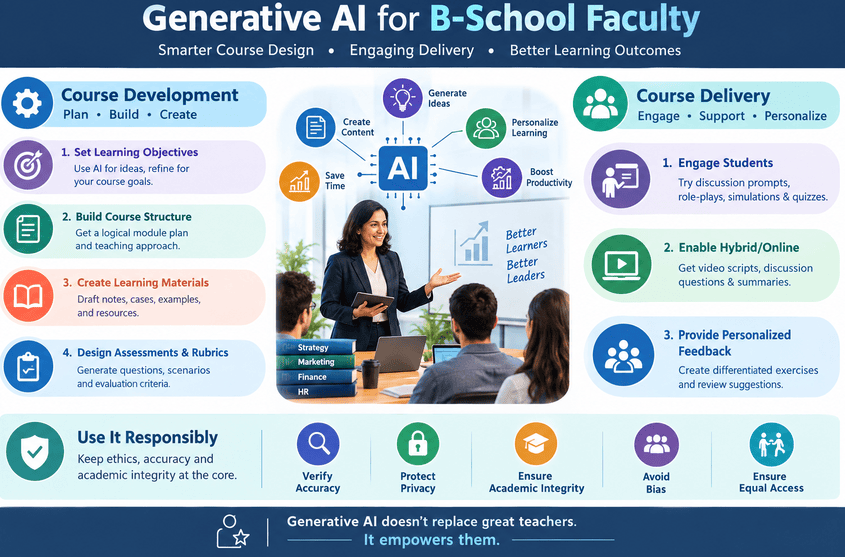
Introduction
Business education is undergoing a significant transformation. The rapid growth of digital technologies, changing business models, and evolving workplace expectations have created a need for management graduates who can think critically, solve complex problems, communicate effectively, and adapt to uncertainty. Business schools, therefore, must continuously improve their teaching methods and learning experiences. In this context, Generative Artificial Intelligence (GenAI) has emerged as a powerful tool that can support faculty in designing, developing, and delivering high-quality courses.
Generative AI refers to artificial intelligence systems capable of creating new content, including text, images, presentations, case studies, questions, and learning activities. Tools such as ChatGPT, Microsoft Copilot, Google Gemini, and other AI assistants can act as academic co-pilots for faculty members. However, their value depends not merely on their ability to generate content but on how thoughtfully educators use, evaluate, and integrate that content into the learning process.
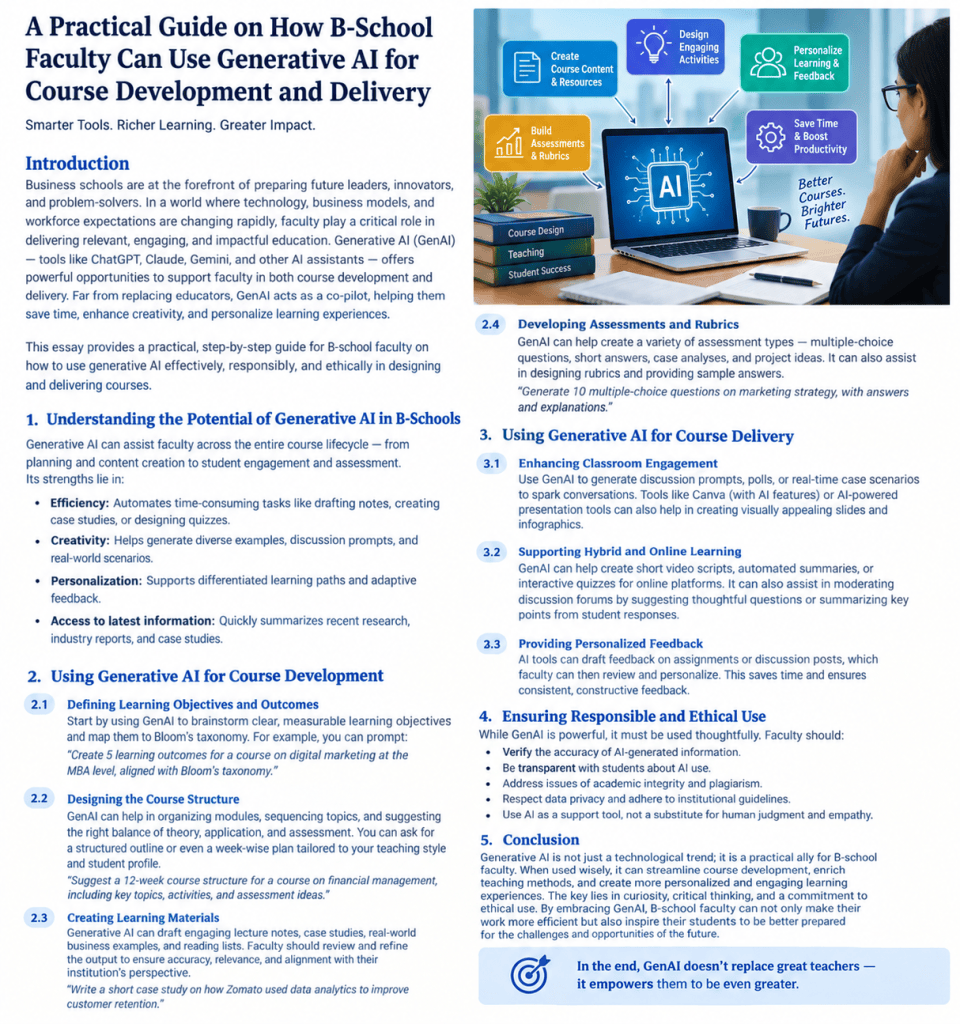
This essay presents a practical guide for B-school faculty on using Generative AI effectively, responsibly, and creatively for course development and delivery.
1. Understanding the Potential of Generative AI in Business Education
Before adopting GenAI, faculty should understand its role in the academic process. It is not a replacement for subject expertise, teaching experience, or human judgment. Instead, it can assist educators throughout the course lifecycle, from planning and content creation to classroom engagement and assessment.
One of its greatest advantages is efficiency. Faculty often spend considerable time preparing lecture notes, presentations, quizzes, assignments, and feedback. GenAI can help generate initial drafts and suggestions, allowing faculty to devote more time to mentoring students and improving classroom interactions.
GenAI also supports creativity. It can suggest real-world business scenarios, alternative explanations, discussion questions, and interdisciplinary connections. For example, a marketing professor can ask AI to develop a classroom scenario involving digital customer engagement, while a finance professor can request a simplified explanation of financial risk for beginners.
However, AI-generated content must always be reviewed for accuracy, relevance, bias, and alignment with institutional learning objectives.
2. Using Generative AI for Course Development
2.1 Defining Learning Objectives
Effective course development begins with clearly defined learning outcomes. Faculty can use GenAI to brainstorm measurable objectives aligned with Bloom’s taxonomy. For instance, while designing a course on digital marketing, a faculty member may ask:
“Develop five measurable learning outcomes for a postgraduate course on digital marketing, covering knowledge, application, analysis, evaluation, and creation.”
AI can suggest learning outcomes that move beyond memorization toward practical business competencies. Faculty should then refine these outcomes according to the course level, programme requirements, and institutional standards.
The key principle is that AI should support the design process, while the faculty member remains responsible for ensuring that the outcomes are academically meaningful and achievable.
2.2 Designing the Course Structure
GenAI can help organize a course into modules, topics, activities, and assessments. Faculty may ask it to suggest a 12-week course structure for subjects such as Strategic Management, Business Analytics, Human Resource Management, or Entrepreneurship.
For example, a Strategic Management course might be organized around environmental analysis, competitive advantage, corporate strategy, implementation, and performance evaluation. AI can propose a logical sequence and identify possible connections between concepts.
Faculty can also use AI to compare different teaching approaches, such as a lecture-based structure, case-based learning, or a blended learning model. The final structure should reflect the course objectives, student profile, available resources, and the institution’s academic framework.
2.3 Creating Teaching and Learning Materials
One of the most useful applications of GenAI is the preparation of teaching materials. Faculty can use it to draft lecture notes, presentation outlines, summaries, examples, case-study questions, and reading guides.
For instance, an educator teaching Operations Management may ask AI to explain inventory management using a retail business example. The generated explanation can then be adapted to suit the students’ knowledge level and linked to relevant theories.
AI can also help create multiple versions of an explanation. A complex concept such as organizational culture can be presented through a definition, a business example, a short story, or a classroom activity.
Nevertheless, faculty should verify all factual claims, statistics, references, and business examples. AI-generated citations may be inaccurate or nonexistent. Reliable textbooks, academic journals, industry reports, and official sources should remain the foundation of course content.
2.4 Developing Assessments and Rubrics
Generative AI can assist in designing diverse and meaningful assessments. Faculty can use it to create multiple-choice questions, short-answer questions, case analyses, simulations, group projects, and reflective assignments.
For example, a professor teaching Business Ethics may ask:
“Create a case study involving an ethical dilemma in corporate governance, followed by discussion questions that require students to analyze alternatives and justify their decisions.”
AI can also support rubric development by suggesting criteria for evaluating presentations, reports, teamwork, critical thinking, and problem-solving.
However, assessments should be designed in ways that encourage original thinking. Instead of asking students to reproduce information that AI can easily generate, faculty should emphasize analysis, application, reflection, and real-world decision-making.
3. Using Generative AI for Course Delivery
3.1 Enhancing Classroom Engagement
GenAI can make classroom teaching more interactive and learner-centered. Faculty can use it to generate discussion prompts, role-play situations, business simulations, and debate topics.
In a Human Resource Management class, students might be assigned different roles in a workplace conflict and asked to negotiate a solution. AI can help prepare the scenario, role descriptions, and follow-up questions.
Faculty can also use AI to develop quick quizzes and knowledge checks during lectures. These activities help identify student misunderstandings and create opportunities for immediate clarification.
The goal should not be to use AI simply because it is technologically advanced. Every AI-supported activity should have a clear educational purpose.
3.2 Supporting Hybrid and Online Learning
Business schools increasingly use blended and online learning models. GenAI can support these formats by helping faculty prepare short video scripts, online discussion questions, study summaries, and interactive learning activities.
For example, after a lecture on financial management, AI can help generate a concise revision summary and a set of application-based questions for students to attempt online.
Faculty can also use AI to moderate learning discussions by suggesting questions that encourage deeper reflection. However, educators should remain actively involved in online forums rather than allowing AI to replace meaningful teacher-student interaction.
3.3 Providing Personalized Feedback
Students have different levels of prior knowledge, learning speeds, and academic needs. GenAI can help faculty create differentiated learning support.
For example, an educator can prepare three versions of a practice exercise: introductory, intermediate, and advanced. AI can also help draft feedback on student assignments, identify areas that need improvement, and suggest additional practice questions.
However, feedback should not be blindly copied from AI output. Faculty must review it, add context, and ensure that it is fair, constructive, and relevant to the student’s actual work.
Personalized learning is most effective when AI-supported feedback is combined with human encouragement, academic guidance, and mentoring.
4. Responsible and Ethical Use of Generative AI
The use of GenAI in business education raises important ethical and academic concerns. Faculty must ensure that AI adoption strengthens, rather than weakens, educational integrity.
First, accuracy must be verified. AI systems can produce incorrect information, misleading explanations, or fabricated references. Second, privacy must be protected. Faculty should avoid entering confidential student information, examination papers, institutional records, or sensitive research data into tools without appropriate safeguards.
Third, academic integrity should be clearly communicated. Students must understand when AI use is permitted, how it should be acknowledged, and which tasks require independent work. Faculty should design assessments that reward genuine understanding rather than simple AI-generated submissions.
Finally, faculty should be aware of algorithmic bias and unequal access to technology. AI-generated examples should represent diverse perspectives, industries, and communities. Institutions should also provide training and access so that the benefits of AI are not limited to a small group of educators or students.
5. A Practical Implementation Framework
A useful way to begin is through a small pilot project. Faculty can select one course or module and identify tasks where AI may provide the greatest value.
The implementation process may include the following steps:
- Identify a teaching challenge, such as time-consuming content preparation or limited classroom engagement.
- Select an appropriate AI tool and learn its capabilities and limitations.
- Write clear prompts that specify the subject, audience, learning objective, and desired output.
- Review and fact-check the generated content.
- Adapt the material to reflect the institution’s curriculum and teaching philosophy.
- Use the AI-supported resource in class and collect student feedback.
- Evaluate whether it improved learning, efficiency, or engagement.
- Refine the approach before expanding its use.
Faculty development programmes and peer-sharing sessions can further encourage responsible experimentation and the exchange of effective practices.
Conclusion
Generative AI offers B-school faculty an opportunity to rethink course development and delivery. It can reduce repetitive workload, support creative lesson planning, enhance classroom engagement, assist assessment design, and provide more personalized learning support.
Yet the successful adoption of AI depends on thoughtful implementation. Faculty must remain the intellectual leaders of their courses, ensuring that technology serves academic objectives rather than driving them. Accuracy, ethics, privacy, academic integrity, and human judgment must remain central to every AI-supported activity.
The future of business education will not be defined simply by how much AI a faculty member uses, but by how effectively that technology is integrated with sound pedagogy, subject expertise, and meaningful student interaction.
Generative AI does not replace great teachers. It empowers them to create richer learning experiences, work more efficiently, and prepare students for a rapidly changing world.


