Financial markets have undergone several transformative phases over the past century—from the globalization of capital markets and the rise of electronic trading to the emergence of algorithmic investing and artificial intelligence. Among these developments, cryptocurrencies represent one of the most disruptive innovations of the digital era. Originally introduced with the launch of Bitcoin in 2009 as a decentralized alternative to government-issued currencies, cryptocurrencies have evolved into a sophisticated financial ecosystem encompassing digital assets, decentralized finance (DeFi), tokenized securities, stablecoins, and blockchain-based payment systems. Today, they are no longer confined to technology enthusiasts or speculative traders. Institutional investors, multinational corporations, regulators, and central banks increasingly recognize cryptocurrencies as an influential component of modern financial markets.
The significance of cryptocurrencies lies not merely in their ability to function as digital money but in their capacity to reshape the structure and behavior of financial markets. They challenge conventional assumptions regarding trust, ownership, market participation, and financial intermediation. At the same time, they introduce new forms of volatility, regulatory uncertainty, and systemic risk. Understanding how cryptocurrencies affect financial markets therefore requires examining both their transformative potential and the complexities they introduce into the global financial system.
Cryptocurrencies Have Become a New Asset Class
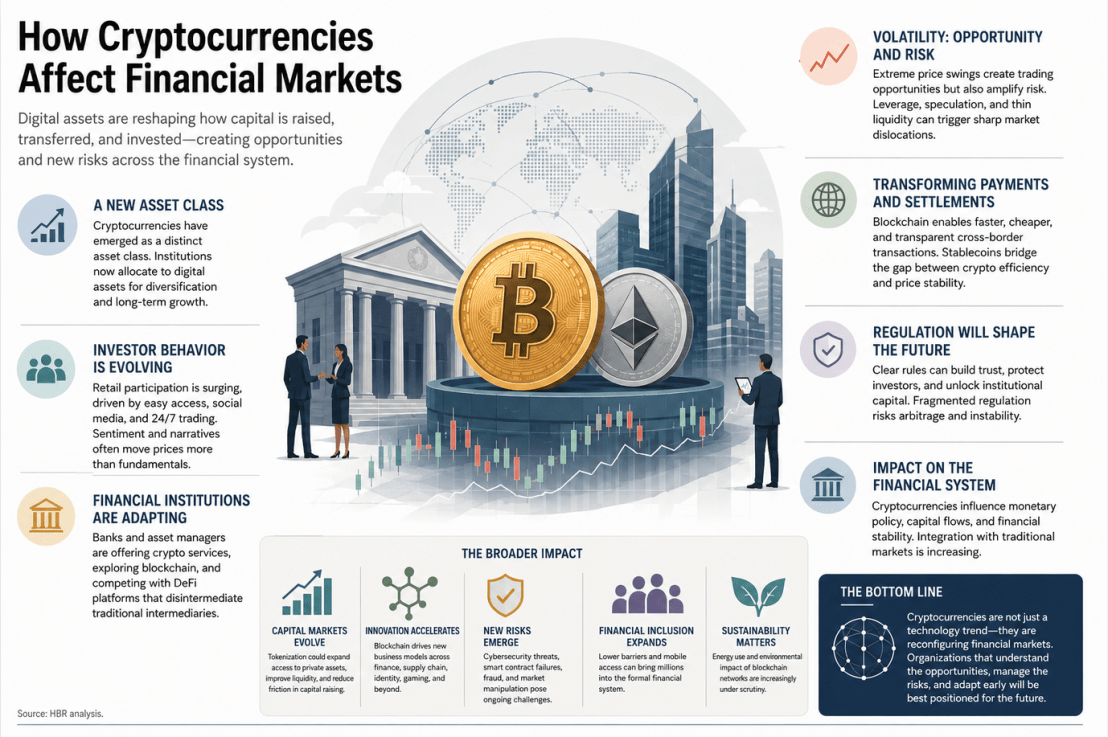
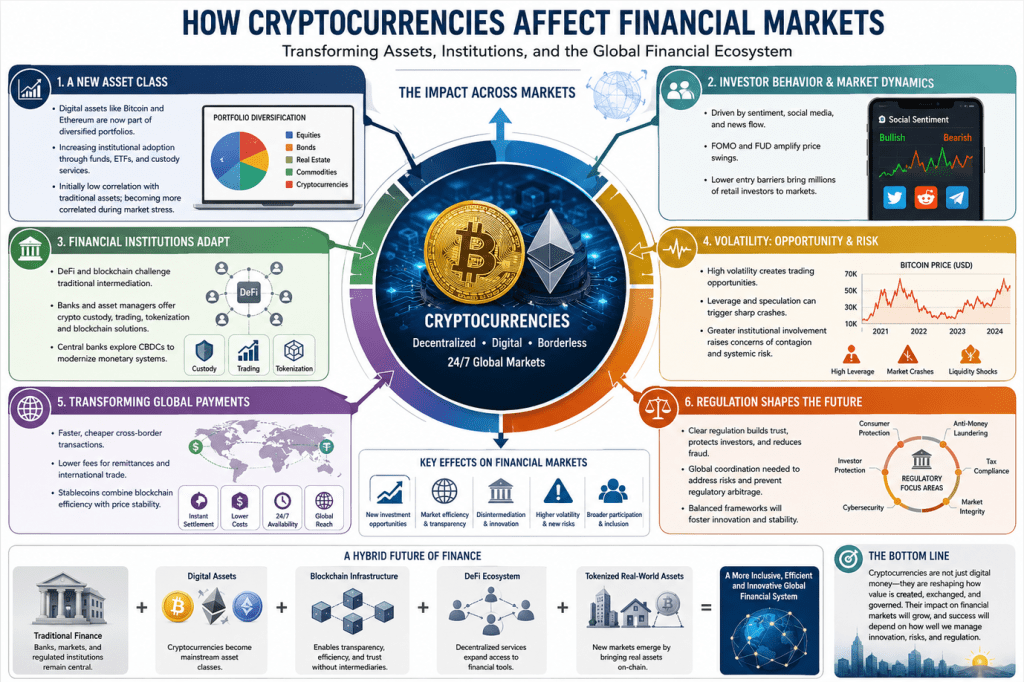
One of the most visible impacts of cryptocurrencies has been the creation of an entirely new asset class. Similar to commodities, equities, and bonds, digital assets now occupy a place within diversified investment portfolios. Large institutional investors, pension funds, hedge funds, family offices, and sovereign wealth funds have gradually increased their exposure to cryptocurrencies, particularly Bitcoin and Ethereum. The approval of cryptocurrency-based exchange-traded funds (ETFs) in several jurisdictions has further legitimized digital assets and made them accessible to mainstream investors.
Unlike traditional assets, cryptocurrencies operate continuously across global markets without geographical or temporal limitations. Trading occurs twenty-four hours a day, seven days a week, resulting in continuous price discovery and unprecedented market responsiveness. While this constant liquidity creates new investment opportunities, it also exposes investors to uninterrupted market risk, where prices can fluctuate dramatically within hours.
Initially, portfolio managers viewed cryptocurrencies as diversification instruments because of their relatively weak correlation with traditional financial assets. However, recent evidence suggests that during periods of economic uncertainty and financial stress, cryptocurrencies increasingly move in tandem with technology stocks and other high-risk assets. Consequently, while digital assets may continue to offer diversification benefits over longer investment horizons, their short-term behavior increasingly reflects broader investor sentiment within global financial markets.
Investor Behavior Is Reshaping Market Dynamics
Perhaps the most distinctive characteristic of cryptocurrency markets is the dominant role played by investor psychology. Traditional financial markets generally derive value from measurable economic fundamentals such as corporate earnings, dividends, cash flows, and macroeconomic performance. Cryptocurrency valuations, by contrast, remain heavily influenced by market expectations, technological optimism, regulatory announcements, and collective sentiment.
Social media platforms, online investment communities, and influential public figures have become significant drivers of cryptocurrency prices. Positive announcements regarding institutional adoption or regulatory support frequently trigger rapid buying activity, while negative news relating to cybersecurity breaches or government restrictions often leads to widespread selling. This heightened sensitivity to information amplifies market volatility far beyond that observed in many conventional asset classes.
The cryptocurrency ecosystem has also democratized financial participation by lowering entry barriers for retail investors. Fractional ownership allows individuals to invest relatively small amounts, while digital trading platforms provide easy access to global markets. As a result, millions of first-time investors have entered financial markets through cryptocurrencies rather than traditional investment vehicles. While this expansion promotes financial inclusion, it also exposes inexperienced investors to speculative bubbles, misinformation, and substantial financial losses.
Financial Institutions Are Being Forced to Adapt
The rapid growth of cryptocurrencies has fundamentally altered the competitive landscape for banks and financial institutions. Traditionally, banks have acted as trusted intermediaries responsible for payments, lending, custody, and financial record keeping. Blockchain technology challenges this model by enabling peer-to-peer transactions that eliminate many intermediary functions.
Decentralized Finance (DeFi) platforms now allow users to lend, borrow, trade, insure assets, and earn investment returns without conventional financial institutions. Smart contracts automate these transactions, reducing operational costs while increasing transparency and accessibility. Although DeFi remains relatively small compared to traditional banking, its rapid expansion signals a broader shift toward decentralized financial infrastructures.
Rather than resisting these developments, many financial institutions have chosen to participate. Global investment banks now offer cryptocurrency custody services, digital asset trading, blockchain consulting, and tokenization platforms. Asset management firms increasingly include cryptocurrency products within their investment portfolios, while payment providers have integrated cryptocurrency transactions into their digital payment systems.
Simultaneously, central banks across numerous countries are actively developing Central Bank Digital Currencies (CBDCs). Unlike decentralized cryptocurrencies, CBDCs preserve governmental control over monetary systems while incorporating many technological advantages associated with blockchain. The coexistence of decentralized cryptocurrencies and government-issued digital currencies may ultimately redefine the architecture of future financial systems.
Market Volatility Creates Both Opportunity and Risk
The extraordinary volatility associated with cryptocurrency markets remains one of their defining characteristics. Price movements exceeding ten percent within a single trading day are not uncommon, making cryptocurrencies considerably more volatile than most equities, commodities, or foreign exchange markets.
Several structural factors contribute to this volatility. Cryptocurrency prices are determined almost entirely by market demand and supply rather than underlying cash flows or intrinsic valuation metrics. Regulatory announcements, technological innovations, cybersecurity incidents, macroeconomic developments, and speculative trading all influence prices simultaneously. Furthermore, cryptocurrency derivative markets permit substantial leverage, magnifying both gains and losses.
From an investment perspective, volatility creates opportunities for active traders seeking short-term profits. However, it also increases portfolio risk, particularly for retail investors lacking sophisticated risk management strategies. During major market corrections, forced liquidations of leveraged positions frequently accelerate price declines, contributing to cascading market crashes.
As institutional ownership increases, concerns regarding financial contagion have also intensified. Although cryptocurrency markets remain relatively small compared to global equity and bond markets, stronger integration with mainstream financial institutions increases the possibility that severe cryptocurrency downturns could influence broader financial stability.
Cryptocurrencies Are Transforming Global Payments
One of the most practical contributions of cryptocurrencies lies in their potential to improve cross-border payments. Traditional international money transfers often require multiple intermediary banks, resulting in high transaction costs, lengthy settlement periods, and foreign exchange conversion expenses.
Blockchain networks significantly reduce these inefficiencies by enabling near-instant settlement between participants regardless of geographical location. For international businesses, exporters, and migrant workers sending remittances, cryptocurrencies offer faster and often less expensive alternatives to conventional payment systems.
Stablecoins have further expanded these opportunities by minimizing the price volatility associated with conventional cryptocurrencies. Because their value is linked to established fiat currencies such as the U.S. dollar, stablecoins combine the efficiency of blockchain technology with greater pricing stability, making them increasingly attractive for commercial transactions and international settlements.
While widespread adoption remains constrained by regulatory uncertainty and infrastructure limitations, blockchain-based payment systems are steadily influencing how financial institutions and multinational corporations approach global transactions.
Regulation Will Shape the Next Phase of Growth
The future influence of cryptocurrencies on financial markets will depend largely upon regulatory evolution. Governments worldwide face the challenge of balancing technological innovation with investor protection and financial stability.
Appropriate regulation can improve market transparency, reduce fraud, strengthen cybersecurity standards, and encourage institutional participation. Clear taxation policies and standardized reporting requirements also increase market legitimacy while reducing legal uncertainty for investors and businesses.
Conversely, fragmented regulatory approaches across jurisdictions create opportunities for regulatory arbitrage, allowing market participants to relocate activities to countries with less restrictive oversight. Because cryptocurrencies operate across national boundaries, effective governance increasingly requires international cooperation among regulators, central banks, and financial institutions.
The challenge is not to eliminate cryptocurrencies but to establish governance frameworks that preserve innovation while mitigating systemic risks.
The Future Financial System Will Be Hybrid
Rather than replacing traditional financial markets, cryptocurrencies are increasingly becoming integrated within them. The emerging financial ecosystem is likely to combine conventional banking institutions, blockchain infrastructure, decentralized financial services, digital payment systems, and tokenized real-world assets into a hybrid model.
Financial innovation rarely eliminates existing institutions; instead, it transforms their functions. Just as electronic trading enhanced rather than replaced stock exchanges, cryptocurrencies are more likely to complement existing financial systems than completely disrupt them. Banks will continue providing regulated financial services, while blockchain technologies improve efficiency, transparency, and accessibility.
For investors, policymakers, and business leaders, the central question is therefore no longer whether cryptocurrencies will influence financial markets, but how quickly and extensively this integration will occur.
Conclusion
Cryptocurrencies have evolved from experimental digital currencies into influential financial instruments capable of reshaping global markets. They have expanded investment opportunities, accelerated financial innovation, challenged traditional banking models, improved cross-border payment systems, and encouraged the development of decentralized financial ecosystems. At the same time, they have introduced unprecedented levels of market volatility, speculative behavior, cybersecurity concerns, and regulatory complexity.
Their long-term impact will depend not solely on technological advancement but on the ability of institutions, regulators, and investors to develop governance mechanisms that balance innovation with financial stability. As blockchain technologies mature and regulatory frameworks become more coherent, cryptocurrencies are likely to become embedded within the broader financial system rather than existing as an alternative to it.
For executives, investors, and policymakers, the strategic implication is clear: cryptocurrencies should no longer be viewed as a peripheral technological phenomenon. They represent a structural shift in how value is created, exchanged, and governed in financial markets. Organizations that understand this transition—and adapt their strategies accordingly—will be better positioned to compete in an increasingly digital and decentralized global economy.


