In an economy where attention has become one of the scarcest organizational resources, productivity is increasingly less about working longer and more about working with deliberate focus. Yet knowledge workers routinely move between emails, meetings, instant messages, social media, documents, and complex tasks. The result is a workday that can feel intensely busy while producing surprisingly little meaningful progress. The Pomodoro Technique offers a deceptively simple response: structure work into short periods of concentrated effort separated by deliberate breaks.
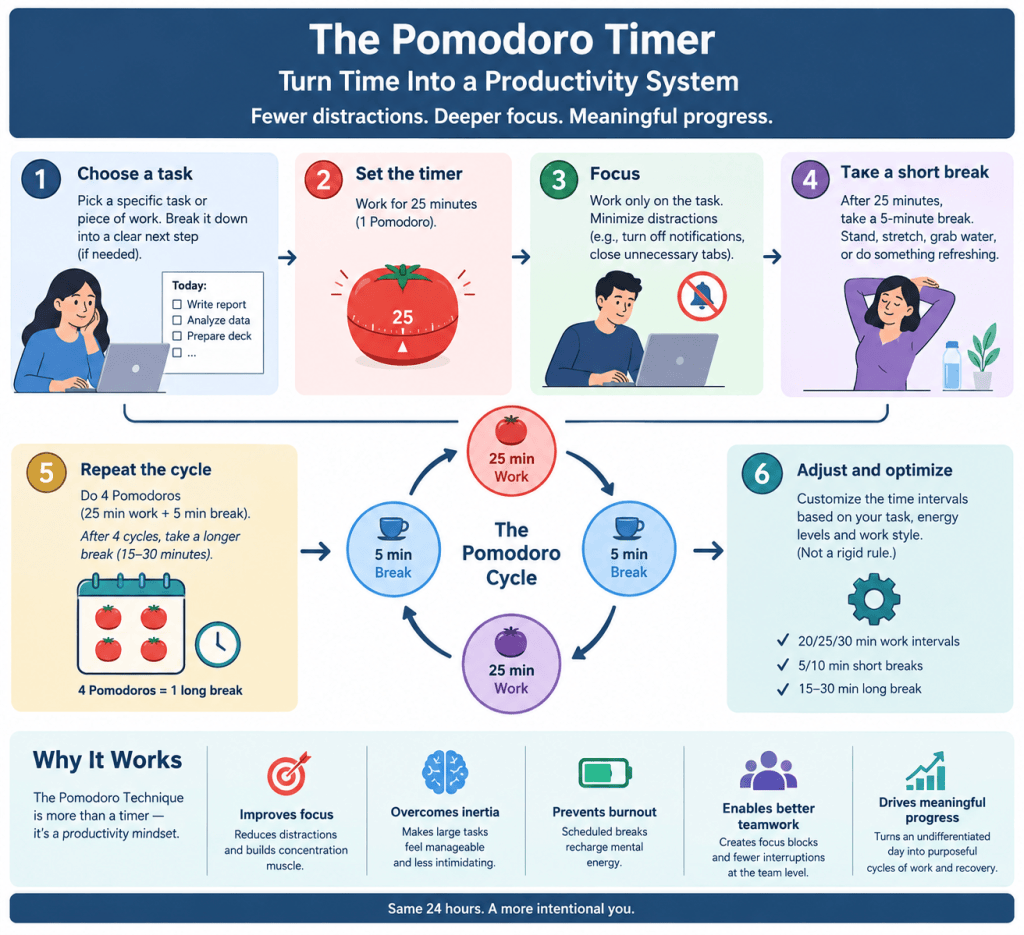
Developed by Francesco Cirillo, the method traditionally divides work into 25-minute intervals, known as “Pomodoros,” followed by short breaks. After several cycles, the worker takes a longer break. The underlying principle is straightforward: rather than asking, “How much can I accomplish today?” the individual asks, “What can I accomplish during the next focused interval?”
This subtle shift changes the psychology of work. Large projects often create cognitive resistance because their boundaries are unclear. Writing a report, analyzing a dataset, preparing a presentation, or developing a strategy can appear to require hours of uninterrupted effort. A 25-minute commitment makes the task psychologically smaller. The objective is no longer to finish the project; it is to make meaningful progress before the timer rings.
The technique can also create a valuable barrier against interruptions. When employees know that they have a defined period for concentrated work, they can temporarily postpone nonessential notifications, email checking, and informal conversations. The timer creates an explicit contract with oneself: for the duration of the interval, the task at hand receives priority.
However, the real value of Pomodoro lies not in the number 25. Some tasks require longer periods of uninterrupted concentration, while others benefit from shorter cycles. A software developer solving a complex architectural problem, for example, may need 45 or 60 minutes before taking a break. A manager processing routine administrative work may find 20-minute intervals more appropriate. The method should therefore be viewed as a framework for protecting attention rather than a rigid formula.
Breaks are equally important. Productivity systems often focus exclusively on maximizing active work, overlooking the role of recovery. Short pauses allow individuals to disengage from one cognitive task before beginning another. Over a full workday, these recovery periods can help prevent the gradual deterioration in attention that accompanies prolonged, uninterrupted work.
Organizations can also adapt the principle at a broader level. Teams might establish “focus blocks” during which meetings and internal communications are minimized. Managers can distinguish between work requiring deep concentration and work that can be handled asynchronously. In this sense, Pomodoro becomes more than an individual productivity technique; it becomes a design principle for knowledge work.
The ultimate lesson is that productivity is not simply a function of time available. It is a function of how deliberately that time is allocated. By converting an undifferentiated workday into purposeful cycles of focus and recovery, the Pomodoro Technique gives employees a practical mechanism for reclaiming attention. Its greatest contribution may therefore be psychological rather than mechanical: it transforms productivity from a vague aspiration into a sequence of manageable commitments.


