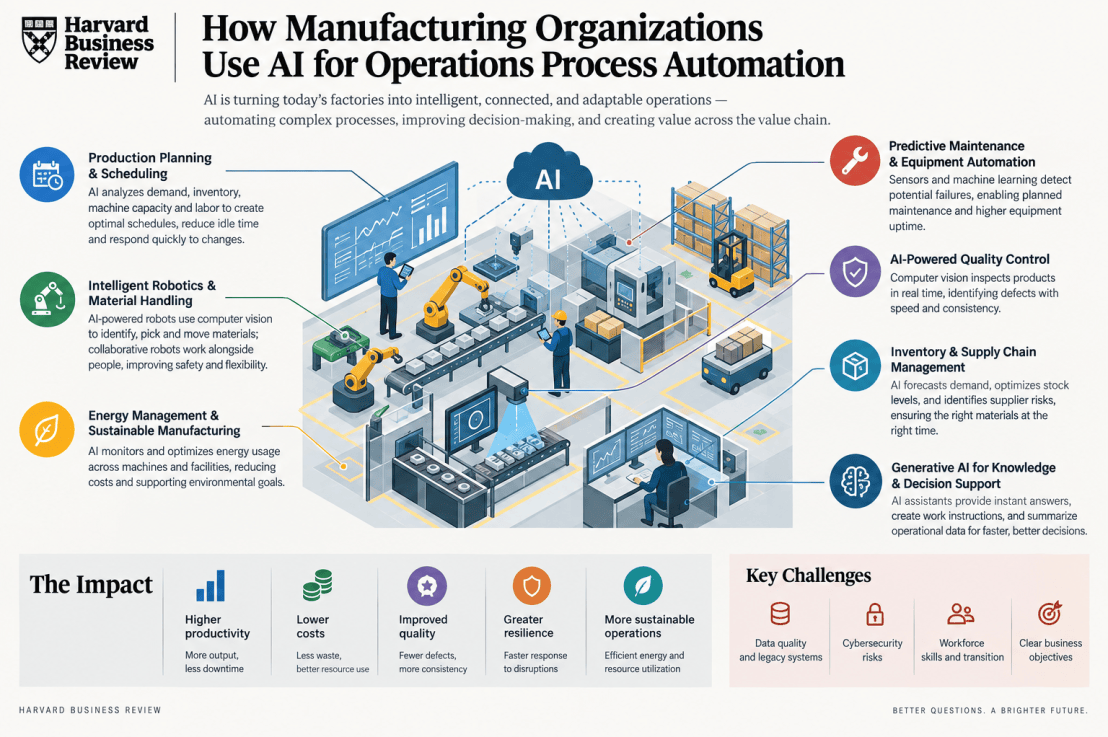
Manufacturing organizations are undergoing a fundamental transformation as Artificial Intelligence (AI) becomes an integral part of operations management. Traditionally, manufacturing relied on manual supervision, fixed automation systems, and rule-based decision-making. Today, AI enables organizations to automate complex processes, analyze vast amounts of operational data, and make intelligent decisions with greater speed and accuracy. From production planning and predictive maintenance to quality control and supply chain management, AI is reshaping how factories operate. By combining machine learning, computer vision, robotics, and generative AI, manufacturers can improve productivity, reduce costs, and build more flexible and resilient operations.
1. AI in Production Planning and Scheduling
One of the most important applications of AI in manufacturing is production planning and scheduling. Manufacturing operations involve coordinating machines, raw materials, labor, production deadlines, and customer orders. Traditional planning methods often depend on spreadsheets, historical experience, and fixed scheduling rules. These methods become inefficient when demand changes, machines break down, or materials are delayed.
AI-powered planning systems can analyze historical production data, customer demand, inventory levels, machine availability, and workforce capacity to create optimized production schedules. Machine learning algorithms identify demand patterns and help organizations forecast future requirements. AI can also recommend how production jobs should be assigned to different machines to minimize idle time, reduce setup changes, and maximize throughput.
For example, an automobile manufacturer producing multiple vehicle models can use AI to determine the most efficient sequence for assembling different models. The system can consider component availability, assembly-line capacity, and delivery commitments. If a machine becomes unavailable, AI can suggest alternative schedules and help planners respond quickly.
2. Predictive Maintenance and Equipment Automation
Manufacturing productivity depends heavily on the reliability of machines and equipment. Unexpected breakdowns can cause production delays, increased repair costs, and missed customer deliveries. Traditional maintenance approaches are either reactive, where equipment is repaired after failure, or preventive, where maintenance is performed at fixed intervals.
AI enables a more intelligent approach through predictive maintenance. Sensors installed on machines collect data such as temperature, vibration, pressure, energy consumption, and operating speed. Machine learning models analyze these signals to identify unusual patterns that may indicate an impending failure.
For instance, an AI system monitoring an industrial motor may detect increasing vibration and temperature. It can alert the maintenance team that the motor may require inspection before a breakdown occurs. This allows organizations to schedule maintenance during planned downtime rather than interrupting production unexpectedly.
AI also supports automated maintenance workflows. When a potential problem is detected, the system can generate a maintenance ticket, identify the relevant equipment manual, recommend inspection steps, and notify the appropriate technician. This reduces manual coordination and improves equipment availability.
However, AI predictions should be treated as decision support, particularly for safety-critical equipment. Human expertise and appropriate engineering checks remain essential.
3. AI-Powered Quality Control
Quality inspection is another area where AI has created significant opportunities for automation. Conventional inspection often relies on human operators who visually examine products for defects. While experienced inspectors are valuable, manual inspection can be time-consuming and inconsistent, especially when products are manufactured at high speed.
Computer vision systems use cameras, sensors, and AI models to inspect products automatically. These systems can identify scratches, cracks, incorrect dimensions, missing components, surface imperfections, and assembly errors. They compare images of products against defined quality standards and flag items that require further inspection.
In electronics manufacturing, for example, AI-powered vision systems can inspect printed circuit boards for missing components or soldering defects. In automobile manufacturing, AI can identify paint imperfections and assembly inconsistencies. In food processing, AI-based inspection can help detect packaging defects and product irregularities.
AI-based quality control provides several benefits:
- Faster inspection and real-time defect detection.
- Greater consistency in identifying visual defects.
- Reduced waste and rework.
- Improved traceability of quality problems.
- Better understanding of recurring production errors.
The most effective systems combine automated inspection with human review for ambiguous or safety-critical defects.
4. Intelligent Robotics and Material Handling
Robotics has been used in manufacturing for decades, particularly in welding, painting, assembly, and packaging. AI is expanding the capabilities of robots by allowing them to interpret their environment, learn from data, and perform tasks that require greater flexibility.
AI-powered robots can use computer vision to identify objects, determine their positions, and select appropriate handling methods. This is particularly useful in warehouses and factories where components arrive in different shapes, orientations, or packaging conditions.
For example, a manufacturing plant may use intelligent robotic arms to pick components from bins and place them on assembly lines. Autonomous mobile robots can transport materials between warehouses and production areas. AI systems can determine the most efficient routes for these robots while considering traffic, obstacles, and changing production priorities.
Collaborative robots, or cobots, can also work alongside human employees on repetitive tasks such as screw fastening, packaging, and component placement. AI allows these systems to adapt to variations in the work environment and support workers more effectively.
The goal is not simply to replace human labor. Instead, AI-enabled robotics can reduce repetitive physical work, improve safety, and allow employees to focus on complex tasks requiring judgment and creativity.
5. AI in Inventory and Supply Chain Management
Manufacturing operations depend on the timely availability of raw materials, components, and finished goods. Excess inventory increases storage costs, while insufficient inventory can stop production. Supply chain disruptions, fluctuating demand, and supplier delays make inventory management especially challenging.
AI helps organizations automate inventory decisions by analyzing sales forecasts, production schedules, supplier performance, lead times, and historical consumption patterns. It can estimate future material requirements and recommend when to reorder components.
For example, an electronics manufacturer may use AI to predict demand for semiconductors and adjust procurement plans accordingly. If a supplier shows signs of delayed delivery, the system can alert procurement managers and suggest alternative suppliers or revised production schedules.
AI can also support warehouse automation. Intelligent systems optimize storage locations, automate stock counting through computer vision, and improve the movement of materials. These applications reduce manual effort and help ensure that the right materials are available at the right time.
6. Generative AI for Operational Knowledge and Decision Support
Generative AI is introducing new possibilities beyond conventional automation. Large language models can help manufacturing organizations manage operational knowledge, assist employees, and automate documentation.
A factory worker may ask an AI assistant, “What are the steps for troubleshooting this machine alarm?” The system can retrieve information from approved equipment manuals, maintenance records, and standard operating procedures. It can then provide a concise explanation in an accessible format.
Generative AI can also help create work instructions, summarize shift reports, prepare maintenance documentation, and analyze production incidents. Managers can use AI assistants to ask questions about production performance and receive summaries of key issues.
For example, a plant manager might ask, “Which production lines experienced the highest downtime this week, and what were the main reasons?” An AI system connected to reliable operational data could summarize the findings and highlight areas requiring attention.
Such systems should use controlled access, verified data, and human oversight to avoid inaccurate recommendations or unauthorized actions.
7. Energy Management and Sustainable Manufacturing
Energy efficiency has become an important priority for manufacturing organizations because of rising operating costs and sustainability commitments. Factories consume substantial amounts of electricity, fuel, and water, making energy optimization a valuable application of AI.
AI systems analyze energy consumption across machines, production lines, and facilities. They identify unusual usage patterns and recommend ways to reduce consumption. For instance, an AI model may detect that a compressor is using excessive energy or that a production line consumes more electricity during certain operating conditions.
AI can also optimize heating, ventilation, air conditioning, and industrial processes according to production requirements. In large facilities, intelligent energy management systems can coordinate equipment operation to reduce peak demand while maintaining production quality.
These applications help organizations reduce waste, improve resource utilization, and support environmental goals.
8. Challenges in Implementing AI Automation
Despite its benefits, AI adoption in manufacturing involves several challenges. The first is data quality. AI models require accurate, reliable, and well-organized data from machines, enterprise systems, and production processes. Many factories operate legacy equipment that may not easily connect to modern digital platforms.
The second challenge is cybersecurity. Connected machines and industrial networks create additional risks if systems are not properly secured. Organizations must protect operational technology from unauthorized access and cyberattacks.
Employee skills are another important consideration. Workers and managers need training to understand AI systems, interpret their outputs, and collaborate with automated technologies. Organizations must also manage concerns about job redesign and workforce transition.
Finally, AI should not be implemented without a clear business objective. A successful project should begin with a specific operational problem, such as reducing downtime, improving quality, or lowering inventory costs. Pilot projects can help organizations measure results before scaling AI across the factory.
Conclusion
AI is transforming manufacturing operations by automating repetitive activities, improving decision-making, and enabling real-time responses to operational challenges. Production planning, predictive maintenance, quality inspection, robotics, inventory management, generative AI, and energy optimization are among the most important areas where manufacturers are applying AI.
The greatest value of AI comes from combining intelligent software with connected machines, reliable data, and skilled employees. Manufacturing organizations that adopt AI strategically can improve productivity, reduce costs, enhance quality, and respond more effectively to changing market demands.
Ultimately, the future of manufacturing is not simply about machines operating without human involvement. It is about creating intelligent, connected, and adaptable operations in which AI handles routine analysis and automation while people provide judgment, innovation, and leadership.


