The rapid rise of generative artificial intelligence (GenAI) has transformed the technological landscape almost overnight. Since the launch of ChatGPT in late 2022, AI has evolved from a niche tool used mainly by experts into a widely accessible assistant capable of writing essays, generating computer code, creating artwork, summarizing reports, and even composing music. Businesses, universities, governments, and individuals have embraced the technology at an unprecedented pace.
But with this rapid adoption has come a growing list of concerns. Can AI be trusted to produce accurate information? Will it reinforce societal biases? Could it be manipulated to spread misinformation or replace human creativity? Most importantly, who will ensure that AI remains aligned with human interests?
A new study published in Business Horizons suggests that the answer may lie in another emerging technology: blockchain.
Rather than viewing artificial intelligence and blockchain as competing innovations, the researchers argue that the two technologies complement one another. While AI excels at generating knowledge and automating tasks, blockchain provides transparency, accountability, and traceability—qualities that are currently missing from many AI systems.
AI’s remarkable capabilities—and growing concerns
Generative AI differs from earlier forms of artificial intelligence because it creates entirely new content instead of simply analyzing existing data. Powered by large language models (LLMs), systems such as ChatGPT can converse naturally with users, answer complex questions, and produce sophisticated written and visual content within seconds. This capability has enormous economic potential. Organizations are already using AI to improve customer service, assist programmers, support medical diagnosis, automate administrative work, and enhance creative industries.
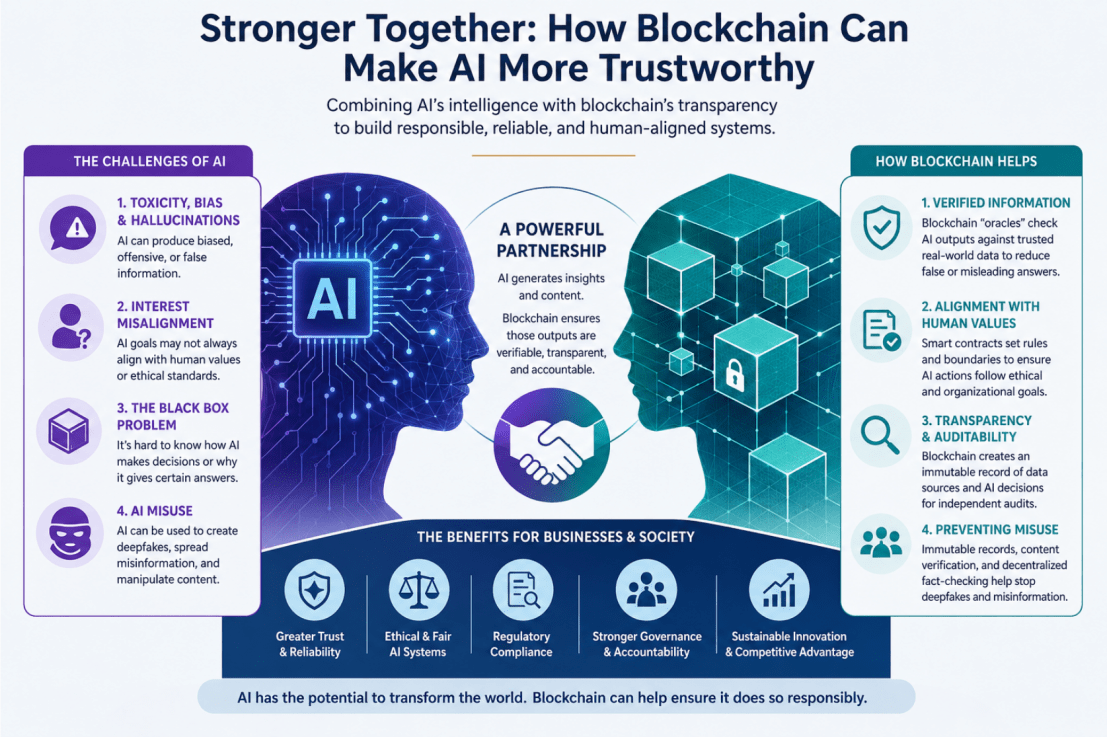
However, the same technology also presents serious challenges. The researchers identify four major problems threatening the responsible adoption of AI.
The first involves toxicity, bias, and hallucinations. AI systems learn from enormous collections of human-generated data. Because that data contains prejudice, misinformation, and inaccuracies, AI may produce offensive language, discriminatory recommendations, or entirely fabricated facts. These so-called “hallucinations” can appear convincing despite being completely false, making them especially dangerous in fields such as healthcare, education, journalism, and scientific research.
The second challenge concerns interest misalignment. AI systems are designed to help users achieve goals, but there is no guarantee that the objectives embedded within these systems always align with human values or ethical standards. Researchers warn that increasingly autonomous AI must be carefully guided to ensure that it consistently supports human interests rather than pursuing unintended outcomes.
A third issue is AI’s notorious black-box nature. Modern language models rely on billions or even trillions of parameters, making it extremely difficult—even for their creators—to explain exactly how they arrive at particular conclusions. This lack of transparency makes it difficult to identify errors, investigate failures, or determine why biased or harmful outputs occur.
Finally, the authors highlight the growing threat of AI misuse. Powerful generative tools can produce convincing deepfake videos, fake news articles, fraudulent documents, manipulated images, and misleading audio recordings. As these tools become increasingly realistic, distinguishing truth from fiction becomes more challenging, posing risks for elections, businesses, financial markets, and public trust.
Blockchain as a technological safeguard
Blockchain is best known as the technology underlying cryptocurrencies such as Bitcoin. However, its greatest strength lies not in digital currency but in its ability to create secure, transparent, and tamper-resistant records. Unlike traditional databases controlled by a single organization, blockchain stores information across decentralized networks. Every transaction is permanently recorded, publicly verifiable, and extremely difficult to alter after the fact. According to the researchers, these characteristics make blockchain a promising companion technology for AI. Instead of replacing AI, blockchain could serve as an independent layer of verification that improves reliability and accountability.
Fighting misinformation with verified data
One of blockchain’s most promising applications is helping AI distinguish reliable information from false information. Research proposes integrating AI with blockchain-based “oracles”—trusted systems that connect blockchain networks to verified real-world data sources. Whenever AI generates a factual claim, the system could compare it against multiple authenticated records stored on blockchain networks. For example, if an AI incorrectly stated the winner of a sporting event or cited a nonexistent scientific source, blockchain verification could immediately detect the error before the response reaches the user. Such systems could significantly reduce hallucinations while improving confidence in AI-generated information.
Aligning AI with human values
Another proposed solution involves the use of smart contracts. Smart contracts are self-executing digital agreements stored on blockchains. They automatically enforce predefined rules whenever specified conditions are met. Researchers suggest that AI systems could operate within these programmable boundaries. Organizations might define which databases AI can access, what types of decisions it is authorized to make, or which ethical guidelines must always be followed. If an AI attempts to violate these predefined conditions, the smart contract could automatically prevent further processing. This creates transparent and verifiable governance rather than relying solely on the internal policies of AI companies.
Opening the AI black box
One of the study’s most innovative proposals involves using blockchain as an audit trail for AI decision-making. Currently, users generally see only their prompt and the AI’s final response. The reasoning process remains hidden. Blockchain could record important stages of AI operations, documenting what data sources were consulted, how information flowed through the system, and how models evolved over time. Because blockchain records cannot easily be modified, auditors, regulators, and researchers would gain access to trustworthy evidence explaining how AI reached specific conclusions. Although recording every AI computation on blockchain remains computationally expensive today, advances in cryptography and specialized blockchain architectures may make such systems practical in the future.
Combating deepfakes and digital deception
Perhaps blockchain’s greatest societal contribution could be combating misinformation.
The study argues that blockchain can create permanent records establishing the authenticity and origin of digital content. Verified creators could register original articles, images, videos, or social media posts on blockchain, allowing anyone to confirm whether content is genuine or manipulated. Smart contracts could also automatically flag or remove verified deepfakes, while decentralized communities could participate in blockchain-based fact-checking systems that reward users for identifying false information. Such mechanisms would make it significantly harder for malicious actors to spread convincing fake content anonymously.
Challenges remain
Despite its promise, blockchain is not presented as a perfect solution. Recording AI operations on public blockchains requires significant computing power and transaction costs. Integrating two highly complex technologies also demands cooperation among AI developers, businesses, regulators, and technology providers. The authors acknowledge that many of their proposals remain conceptual and will require substantial technological advances before they can be implemented at scale.
Looking ahead
The future of responsible artificial intelligence may depend not only on building more powerful AI systems but also on surrounding them with technologies that ensure transparency, accountability, and trust. Artificial intelligence offers extraordinary capabilities in reasoning, creativity, and automation. Blockchain, meanwhile, offers mechanisms for verification, traceability, and decentralized governance. Together, the two technologies could help organizations develop AI systems that are not only more intelligent but also more reliable and ethically aligned. As governments around the world introduce new regulations and businesses increasingly integrate AI into everyday operations, combining blockchain with artificial intelligence may become a crucial step toward ensuring that technological progress benefits society while minimizing its risks.
Brewer, J., Patel, D., Kim, D., & Murray, A. (2024). Navigating the challenges of generative technologies: Proposing the integration of artificial intelligence and blockchain. Business Horizons, 67(5), 525-535.

 Business Frontiers