When Bankers Discovered Diet AI
Financial services have always loved big things: big balance sheets, big buildings, big bonuses. So when generative AI arrived, banks naturally reached for the biggest models available. Then the cloud invoices came in, the compliance team read the data-sharing clauses, and someone in risk asked where exactly customer data was travelling. The mood in the boardroom changed rather quickly.
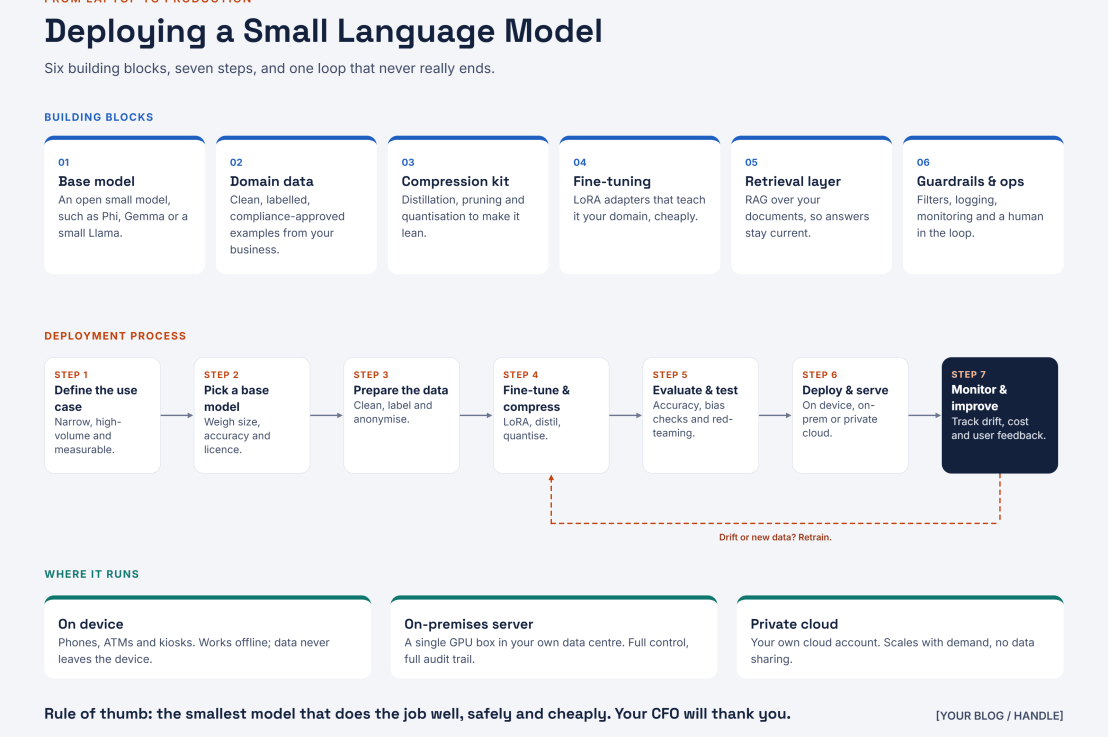
That is where Small Language Models (SLMs) enter the story. These compact models, usually between a few hundred million and around ten billion parameters, can run on a bank’s own servers or even on a customer’s phone. They may not write poetry or debate philosophy, but they can read a loan file, flag a suspicious transaction or answer a balance query in milliseconds. This essay argues that SLMs, not their giant cousins, will do most of the everyday AI work in banking, insurance and capital markets, and that this shift will quietly change the economics, the risk profile and the customer experience of the whole industry.
Why Finance and Small Models Are a Natural Match
Three features of the financial services industry make it unusually well suited to SLMs.
The first is data sensitivity. Banks hold some of the most private information people have: income, spending habits, debts and family details. Sending this data to an external AI service, however secure, raises questions from regulators, auditors and customers. An SLM hosted inside the bank’s own data centre keeps the data at home. In finance, “it never left the building” is not a slogan; it is a compliance strategy.
The second is volume. A large bank processes millions of transactions, documents and customer queries every day. Most of these tasks are narrow and repetitive: classify this complaint, extract the account number from this form, check this payment against a sanctions list. Using a giant general-purpose model for each of these is like hiring a Nobel laureate to sort the morning post. An SLM does the job faster and at a fraction of the cost per query.
The third is speed. Fraud detection, payment authorisation and trading support all happen in real time. A small model that answers in milliseconds is far more useful here than a brilliant one that takes a few seconds to think while the fraudster is already at the checkout counter.
Where the Impact Will Show
Customer service. Today’s banking chatbots are often scripted decision trees that understand you only if you phrase things exactly as they expect. An SLM fine-tuned on a bank’s products and policies can handle natural questions about fees, card blocks, EMI schedules and statement requests, and do it on the bank’s own infrastructure. Some of this can even run inside the mobile app itself, so simple queries work with patchy connectivity.
Fraud and risk. Traditional fraud systems score numbers: amount, location, time. SLMs add the ability to read text, such as transaction descriptions, merchant names, emails and chat messages, and spot patterns that hint at phishing, mule accounts or social engineering. Because they are cheap to run, they can check every transaction rather than a sample.
Compliance and KYC. Compliance teams drown in documents: identity proofs, onboarding forms, regulatory circulars and audit trails. Small models specialised in document extraction and classification can pre-read these files, highlight missing information and summarise new regulations for compliance officers. The human still signs off, but the mountain becomes a manageable hill.
Wealth management and advisory. Relationship managers spend hours preparing for client meetings. An SLM can summarise a client’s portfolio, recent conversations and relevant market notes into a one-page brief. It will not replace the advisor’s judgement, but it gives them back time for the part clients actually value: conversation.
Insurance. Claims processing is full of forms, photos and repair estimates. SLMs can triage claims, extract key details and route simple ones for fast settlement, leaving complex cases to human adjusters. Faster claims mean happier customers, and happier customers renew.
The Indian Angle
India offers an especially strong case for SLMs in finance. The Reserve Bank of India’s rules on storing payment data within the country, along with the Digital Personal Data Protection Act, 2023, push financial institutions to keep sensitive data under tight control. Models that run on domestic infrastructure fit naturally into this framework.
Then there is language. A customer in Kolkata, Coimbatore or Kanpur may prefer Bengali, Tamil or Hindi, or a cheerful mix of each with English. Small models fine-tuned on regional languages can serve these customers at a cost that makes sense even for low-value accounts, which matters enormously for financial inclusion.
Finally, scale. India’s digital payments run into billions of transactions a month. At that volume, the difference between a costly model and a lean one is not a rounding error; it is the difference between a viable product and a very expensive experiment.
The Risks Nobody Should Ignore
Small does not mean safe by default. SLMs carry less general knowledge and can still produce confident but wrong answers. In finance, a hallucinated interest rate or a misread clause is not a funny anecdote; it is a regulatory complaint waiting to happen. Grounding answers in verified documents through retrieval systems, and escalating uncertain cases to humans, will be essential.
There is also the question of explainability. Regulators expect banks to justify decisions such as loan rejections. A model that cannot explain why it flagged an application creates legal and reputational exposure. Banks will need model risk management, regular audits, bias testing and clear documentation for every SLM in production.
Finally, sprawl is a real danger. Because SLMs are cheap, every department may want its own. Without central governance, a bank could end up with fifty small models, each trained differently and monitored by nobody. Small models need big discipline.
The Bottom Line
The future of AI in financial services will not be one giant model sitting in the cloud and answering everything. It will look more like a well-run bank branch: many specialists, each good at one job, with a few senior experts called in for the tough cases. SLMs will be those specialists, handling service queries, fraud checks, document reviews and claims at scale, while large models are reserved for complex reasoning and research.
For banks, insurers and fintechs, the strategic question is shifting from “Which is the most powerful model?” to “Which is the smallest model that does this job well, safely and cheaply?” The institutions that ask that question early will enjoy lower costs, tighter data control and faster service.
In an industry obsessed with returns, that is a rare investment: one where thinking small could deliver very big interest.


